

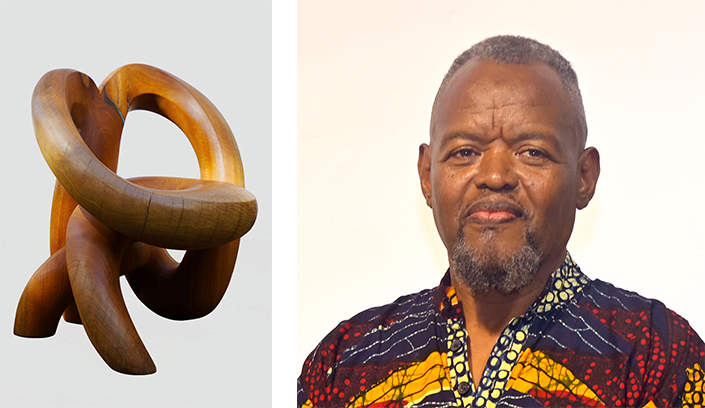

By Thaddeus Wamukoya (Tewa)
In Ancestral Grain, sculptor Gakunju Kaigwa gives fallen trees a second life — one that honors their long memory and the unseen energy they still hold. These trees once stood rooted in the same soil that nourished generations. They have felt the wind that carried songs, the rain that blessed harvests, the footsteps and laughter of those who came before us. Like heirlooms of the earth, they carry the vibration of time — the quiet wisdom of endurance.
In carving, Gakunju listens to what the wood remembers. Each curve, hollow, and surface becomes a conversation between artist and ancestor, between what has passed and what is becoming. His chairs, stools, and tables appear impossibly fluid — as though the wood itself is stretching, bending and remembering how to move again.
Across Africa, carved stools were once a symbol of connection and identity. In his grandfather’s time, a man carried his stool to every gathering, each meeting, each marketplace. It was a personal throne, both functional and sacred. Over the years, these hand-hewn artefacts disappeared from Kenyan homes, replaced by modern furniture that forgot to tell stories.
Gakunju brings them back — not as replicas of the past, but as rebirths. His pieces are larger, weightier, sculptural — too grand to be carried, but meant instead to anchor a home. They are gathering places once more, drawing people into conversation and contemplation. Viewers see different things in each piece — a face, a flame, a creature, a memory — as if the trees themselves are whispering what they once saw.
Each sculpture in Ancestral Grain is a vessel of continuity — where nature, ancestry, and artistry intertwine. In every polished surface and living curve, we are reminded:
The tree never truly dies. It simply changes form — carrying the breath of our ancestors into the spaces where we live, sit, and dream.
 Longonot, 2025, Mango Wood, 60 cm x 79 cm x 55 cm

Thaddeus: Is this your first time working with wood as a sculptor? How was your experience compared to the mediums?
Kaigwa: I’ve worked with wood sculptures before. In the first six years of my career, I worked exclusively in stone. At some point, I realized I was limiting myself because the logistics of finding the sizes of stone I needed became difficult as my ideas grew bigger. I would have had to invest in expensive equipment to move the stone, and it was also challenging to find and quarry pieces of the scale I wanted.
Wood became an alternative. It’s easier to source—you can get long logs and large pieces—and it’s relatively light compared to stone. This allowed me to expand some of the ideas that had been limited by my material. After making a few pieces in wood, I learned how to weld, which then allowed me to go even bigger.
Working with welding allows you to construct a frame, cut sheet metal, and wrap that structure to create hollow forms. The result is surprisingly light, making it possible to extend forms beyond two or even three meters with ease.
Each material, however, brings its own strengths and limitations. I often think of working with a single material as speaking only one language. The moment you begin to explore multiple materials, you become multilingual.
You’re no longer restricted to a single mode of expression. Instead, you build a broader vocabulary and deeper technical knowledge, allowing you to move fluidly between approaches. This freedom opens up the possibility of combining materials—metal, stone, and wood—within a single piece, creating richer and more dynamic work.

Artwork: Msambweni & Eburru | Image: Courtesy of the Artist
Thaddeus: Where do you source your wood?
Kaigwa: I’ve never cut down a tree or gone to a forest to identify a tree for the pieces of wood for my work. Over the years, I’ve built strong working relationships with two or three professional tree cutters. Most of the trees they handle are either cleared for construction or brought down by storms. Whenever they come across suitable wood, they consult me to identify and mark the sections I want for my work. It’s a win-win situation where they call me and they get a ready client from a commercial stand point.
Thaddeus: How long did it take to create this body of work in Ancestral Grain?
Kaigwa: On and off, I would say about two years in total. There were periods when I wasn’t working and would take breaks for a few weeks or even a month at a time, but overall it adds up to roughly two years of experience.

Exhibition Opening | Image courtesy of Godwin Olusegun & Artist
Thaddeus: Describe your creative process
Kaigwa: Looking back at my work, even as far as the 1980s, it has become increasingly clear that it’s not enough for pieces to simply share the same medium—whether painting or sculptures. What gives a collection real strength is a unifying story, narrative, or theme that runs through every piece. Each work should not be seen in isolation, but as part of a larger idea or statement.
Working within a theme helps prevent ideas from becoming scattered. It creates a kind of filter through which every piece must pass, ensuring that all the works belong to a cohesive and intentional body of art.
When I developed a theme for functional sculptures, the central idea was to create pieces from wood that are both aesthetic—able to stand alone as abstract works of art—and functional at the same time. I was interested in blurring the boundary between form and function, and this became the focus of my experimentation. I believe I was successful in achieving that balance.
Thaddeus: Do you work alone or with a team?
Kaigwa: Mostly I work independently because the nature of my work is very personal. I have my own vision, and my process is carefully controlled to achieve a particular result, which makes delegation difficult. In some ways, it feels unfair to impose my will or vision on someone else.
That said, I do occasionally receive help with the final touches that prepare the work for presentation, such as sanding and smoothing surfaces. I especially enjoy carving, and sometimes it is difficult to share that part of the process with anyone else. It may seem selfish not to have assistants, but working alone also means taking full responsibility for the final work. When something goes wrong, there is no one else to blame.
Sculpture requires flexibility — accepting both successes and failures, since not every piece turns out as expected. With commissions, however, I sometimes collaborate with other artists.

Artworks: Elementaita & Sultan | Image courtesy of Artist
Thaddeus: How do you achieve the forms, design and shapes in your work?
Kaigwa: I achieve form in my work through different approaches; none is better than another. What matters is gaining access to the ideas behind the forms I want to create. Sometimes the material itself suggests an idea. If I begin with something like the root of a tree, the way it is constituted can suggest the direction I might take.
Ideas can take months, even a year, to emerge. I have to live with a piece of wood—studying it, turning it over, standing at different angles—until I find a connection. From there, I begin a series of drawings before finally starting work on the piece itself.
The material plays an active role in the process. The more the idea reveals itself, the more it guides me toward the best way forward. As I carve and remove material, the work continues to suggest its own direction—what it needs, and ultimately, what will make it a powerful piece.
That’s part of the dance between the medium and the artist. The artist is the creative force — the energy working on the material — and the material responds in return. It’s an intuitive process. When you’ve been doing it for a long time, you develop a vocabulary for solving the problems that arise during the sculpting process, and that’s how you build a voice.
People look at my work and recognize the similarities in my approach — they can tell it’s mine, that it’s my style. I have a certain signature. I might place very sharp edges beside very soft carvings. That’s the way I’ve chosen to express myself.

Exhibition Opening | Image courtesy of Godwin Olusegun & Artist
Thaddeus: From your perspective as a sculptor, why have sculpture exhibitions become increasingly scarce in Nairobi?
Kaigwa: There are many reasons. I think sculptors are a minority in the Nairobi art ecosystem. In a group of ten artists, you’d be lucky to find three sculptors.
Sculpture as a discipline is very different from other forms of expression, such as painting. In sculpture, you are dealing with three-dimensional forms — it requires a completely different way of thinking and creating compared to painting which is working on two-dimensional surfaces.
Other challenges include access to materials and market restrictions. With painting, a canvas is much easier to transport; it can be rolled up, and you can carry or ship several works for an exhibition quite easily. Sculpture, on the other hand, is bulky.
Sculptures are difficult and expensive to transport and ship, while space is also a major consideration. A sculpture demands a particular kind of spatial presence, both in the way it is displayed and in how viewers experience it. This makes it more challenging to find buyers for sculpture compared to paintings, which are easier to hang, simpler to place within a home or collection, and more adaptable to a buyer’s existing aesthetic preferences.
Thaddeus: Do you think about where your pieces might ultimately live in a collector’s space while you’re creating them?
Kaigwa: When you start limiting where something can go, you don’t know what buyers might have in mind for it. I don’t create work for a specific space unless it’s a commission.
With commissions, you have to factor in a lot — the type of wood, whether it needs to be weatherproof, how it will hold up to the elements, whether it’s intended for an indoor or outdoor space, and if the outdoor area is covered or exposed.

Most of the time, I make my sculptures as experiments. It’s an intuitive process, and the joy is in the creation itself.
When I start a new day, I’m excited either to begin a new piece or to continue working on something that’s unfolding well. The goal is really to satisfy the urge to keep creating.
Sharing the work with people is important, and in the context of an exhibition, it’s always a bonus when collectors resonate with a piece and choose to invest in it.

Olenguruone & Ololua | Image: Courtesy of the Artist
Thaddeus: How do you feel about your work maintaining strong value in the secondary market?
Kaigwa: It’s a form of validation to some extent. Most of the works that appear on the secondary market were originally acquired by collectors who invested in the work years earlier and are now bringing it back to the market.
It’s always interesting to see how, over time, the progression of your career continues to influence the value of the work. You never really know how much that value has grown until a formal setting like an auction places the work at a level you may never have imagined it could reach.
Art can appreciate quite rapidly over the years, depending on the trajectory of an artist’s career. For me, that sense of validation is important.
Thaddeus: Mentorship & Legacy — Having worked for 12 years as an art educator, are there any plans to share your knowledge and experience through workshops, mentorship programs, or other educational initiatives?
Kaigwa: I’ve received similar proposals from several people over the years, but I hadn’t really given them much consideration because my focus was on building this body of work for Ancestral Grain. Now that I have a bit more space and time, I’m open to engaging in further conversations with individuals who may want to partner moving forward.
An art school is definitely not the direction I envision. It feels too formal, and I don’t think that is my role. What I do value, however, is apprenticeship. That’s how I learned much of what I know as a sculptor — by working alongside highly skilled sculptors with years of experience. In that kind of environment, people don’t necessarily need to be formally taught; they observe the work, the process, the discipline, and, if they are genuinely interested, they naturally begin to absorb new ways of working and thinking.
For me, mentorship feels far more meaningful and practical than structured academic programs or regular studio workshops. At this stage in my life, I also simply want to keep creating. One of the biggest challenges during my years of teaching was trying to balance caring for my students while sustaining my own studio practice. My creative work suffered because I often no longer had the energy or inclination to return to the studio afterward.
Now that I’m retired from teaching, I’m in a place where I want to create as much as I can. Time has also become more present in my thinking. I’m very aware that none of us knows how much time we have on this planet, and I want to spend mine making the work that still feels necessary for me to create.
Olorgesailie, 2023, Oak Wood, 77 cm x 68 cm x 45 cm


Thaddeus: What advice would you offer aspiring sculptors?
Kaigwa: One of the things I’ve noticed is that wood or stone carving requires an immense amount of effort. It’s a deeply physical process — you have to build muscles and endurance you may not have been prepared for. It’s also not a fast process, and it’s certainly not for the impatient. You need a great deal of patience, and you have to accept that mistakes are part of the learning.
A lot of people want to run before they can walk. They want to create a masterpiece from the very beginning, but there is so much to learn first: understanding how to use the tools, mastering the technical aspects of the craft, learning the properties of different materials, and recognizing how each material behaves differently.
My advice is to be truly committed. It’s not an easy path, but it is incredibly satisfying. Once you begin to understand what you are doing and become proficient with the technical side of the work, it becomes deeply rewarding — though it always remains challenging. There also has to be genuine passion for it. Without that passion, it becomes difficult to sustain the discipline the work demands.
The materials themselves are often easy to find. My caution, however, is this: before investing heavily in expensive tools and machines, start with only what you need. Give yourself time to discover whether this is truly the direction you want to pursue. Sculpture offers many different paths — modelling with clay, carving, steel fabrication, and more. It’s important not to make major investments in one area before you’ve had the opportunity to explore and understand where your interests genuinely lie.
There is also a business aspect to being a sculptor, just as there is in any artistic discipline. There is never a guarantee that the work will sell once it is completed, so it’s important to understand that sustaining a practice requires both creative and financial investment. You need a budget not only for making the work itself, but also for documenting, presenting, and promoting it. Developing a studio practice therefore demands patience, commitment, and a realistic understanding of the professional side of being an artist.
Ancestral Grain by Gakunju Kaigwa. Opened 18 April runs until 31 May, 2026, Location: Rooftop Gallery, Village Market, 2nd Floor in the Old Wing near Parking Lot
Online Catalogue Link: https://drive.google.com/file/d/1f5ksixNwjnKU6-O2duadeZTIsIuYdZO6/view?usp=sharing
