

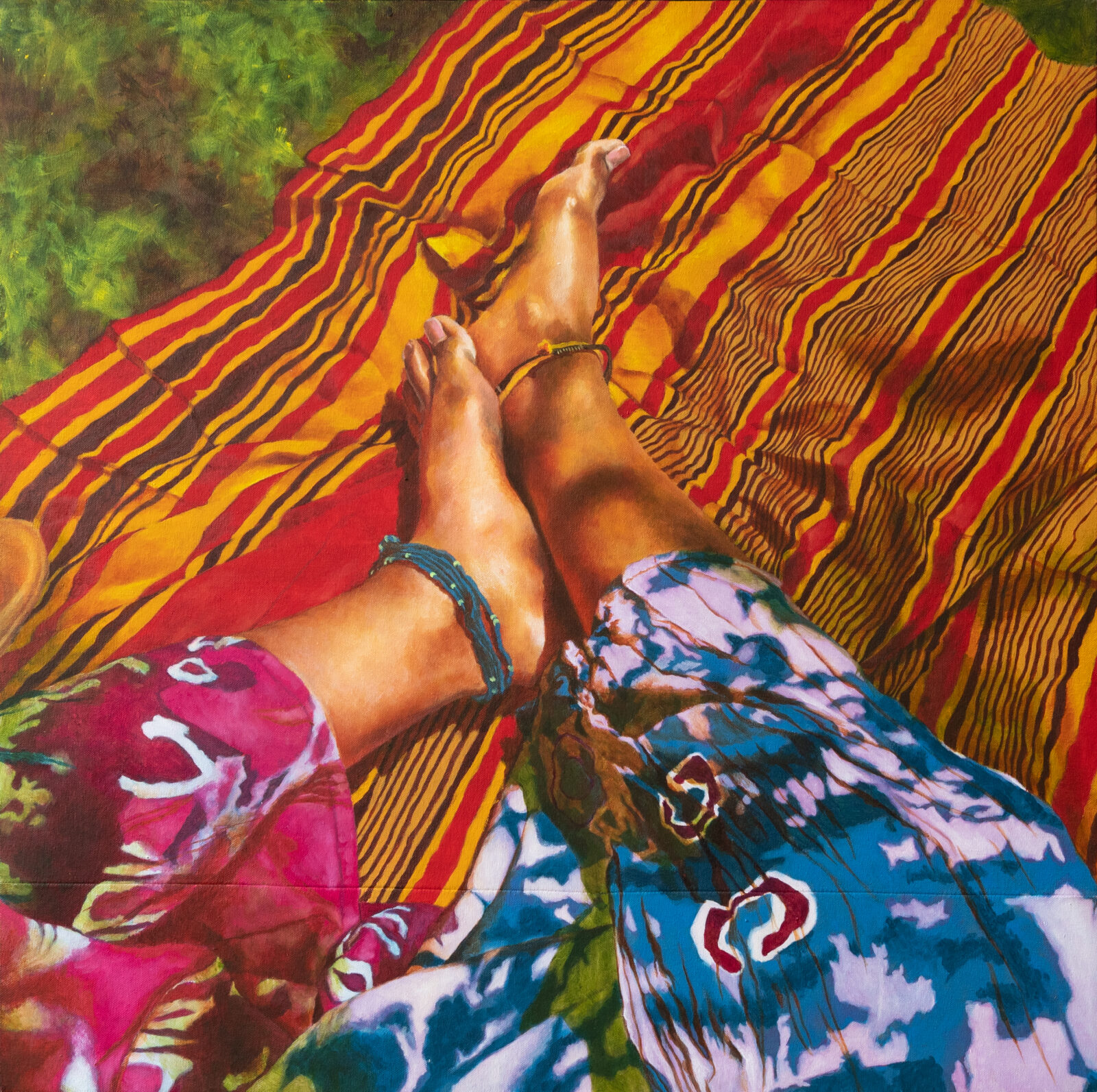

April Kamunde’s current exhibition at The African Arts Trust focuses on a common and seemingly uncomplicated item of clothing: the dera, or dirac – the Somali term from which dera derives.
The Fabric of Our Being builds on Kamunde’s ongoing series Rest: The Pursuit of Peace, itself born of her observation of personal and collective fatigue during the COVID era. In her gallery essay, Kamunde quotes art critic Jessica Horn, invoking the broader social resonance of rest:
“The assertion of the right not to labour is an important one given that African women are expected to perpetually labour…”
Kamunde draws the dera and its nuanced meanings into her examination of rest and the Kenyan woman.
An Exploration of Rest as Revolutionary
The gallery contains a series of luminous paintings of women wearing deras, at rest, in gardens. There is a languid and sultry beauty to the paintings. They are full of the light of sunshine, which the women quietly luxuriate in. The women seem to be enjoying moments of privacy; we experience a sense of voyeurism while looking at the pieces.
Kamunde’s Ode to Somalia series – the first pieces encountered on entry to the show – was inspired by the dera’s origins. While the dera originally hails from Yemen, the pieces reflect the garment’s layered journey through cultural and emotional geographies, from Somalia to Kenya via Coast.
Sitting on a Somali kikoy, identified by its distinctive red and yellow colouring, Kamunde shifts perspective, showing us just the feet and ankles lapped by the hems of deras. You very much feel in the place, as if you are the sitter, looking down at your own body. These images draw from Kamunde’s early portraits of rest while in Lamu, where she first explored these perspectives of herself resting on a rug.
As we round the gallery, we encounter a video piece. The screen is split into three scenarios. In all of them, women are at work, kitchen work or desk work. Wearing deras.
What do you think of when you think of a dera?
Kamunde has meditated on the nuanced messages of the dera, the sending and receiving of which can be contradictory. Kamunde emphasizes how the dera can be a symbol of modesty but simultaneously can be a deeply sensual piece of clothing, covering, yet clinging to a woman’s curves.
In Kenya, the dera is often worn to do housework, or to relax. Kamunde notes that when a woman is wearing a dera, it can be perceived as a signal for privacy. We discussed that women may put them on for errands such as food shopping or dropping the children at school. When you see a woman in a dera doing such errands, you know not to interrupt. You know she is in a private mode.
Kamunde explores respectability politics and the dera’s contested identity in her first installation piece, Two Truths Can Exist at Once, a dual-sided fabric installation. One side celebrates comfort and domesticity; the reverse critiques its association with “laziness.”

The Dera as a Site of Debate
Two pale deras hang from hangers that project from the wall, placing them back to back. The fabric of the deras are stencilled with quotes from friends and family about how they view the dera:
She quotes own view, “I consider the dera/dirac a non-verbal ‘Do Not Disturb’ sign. Whether it’s at home or in the neighborhood, when you see a woman dressed in one in urban Nairobi, you KNOW to just NOT”.
“We adore it as part of our culture and religion of preserving a woman’s sensuality, dignity, and respect. It is an abomination for a Muslim woman to be walking in the streets exposing parts of her body. That is why the dress is still a must for every woman” – Hodan, 80 years old.
In Kamunde’s piece we see that while women find the dera protective, men have a different perception:


“I like the dera, but I prefer my wife wearing it inside. I find it sexy since I can feel her body anytime without much struggle. But I wouldn’t want her to wear it outside since it makes her look older”, says a man from Kilifi.
“Dera ndio kusema. I bought several pieces for my wife, the ones she wears in the house while doing house chores, the ones she puts on while stepping outside the house. The outfit is better on women with a big derriere, especially when worn without inner-wear”, states another.
“Ladies think that wearing deras make them look mature. No! The cotton, transparent dera does not make you look mature, it makes you look lazy…” says Isaac Mangale, his words stenciled onto this very basic piece of cloth.
Rest, Rebellion, and Salted Oranges: The Poetic Power of Kamunde’s Titles
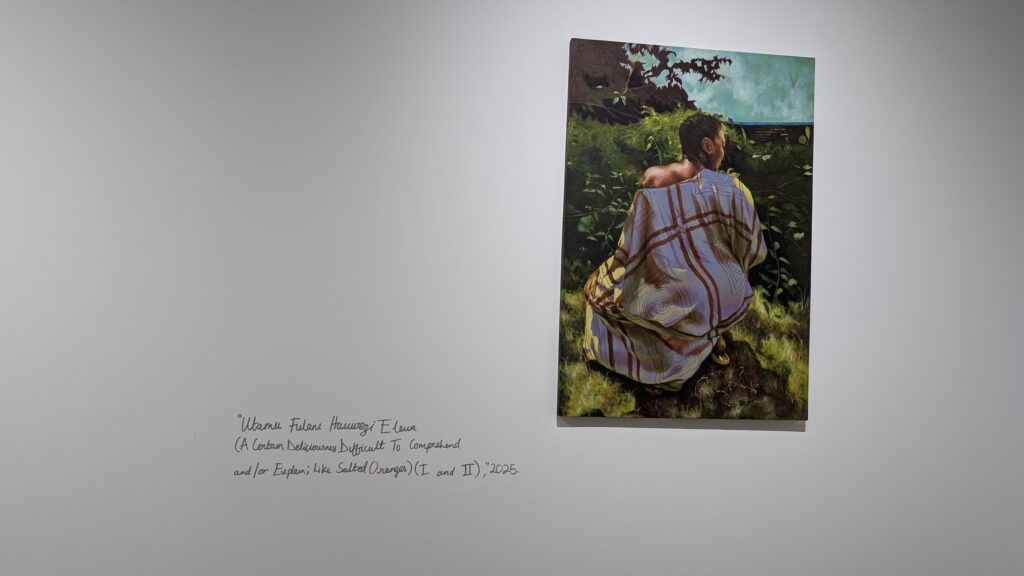
Kamunde says that her titles are as important as the images she has painted and are both humorous and poignant. As such, they are written in Kamunde’s own hand on the wall beside the paintings. “Utamu Fulani Hauwezi Elewa (A Certain Deliciousness Difficult to Comprehend and/or Explain; Like Salted Oranges) describes a voluptuous woman (friend Abi…… ) squatting in the grass, wearing a swirling, silken dera which is slipping off her left shoulder. We see her from behind. In front of her is a hedge. Or perhaps she is behind the hedge, and we are spying on her. On the ground beside her is a string of waist beads, another symbol of sensuality. Taking it all in leads you to wonder what she might have been doing.
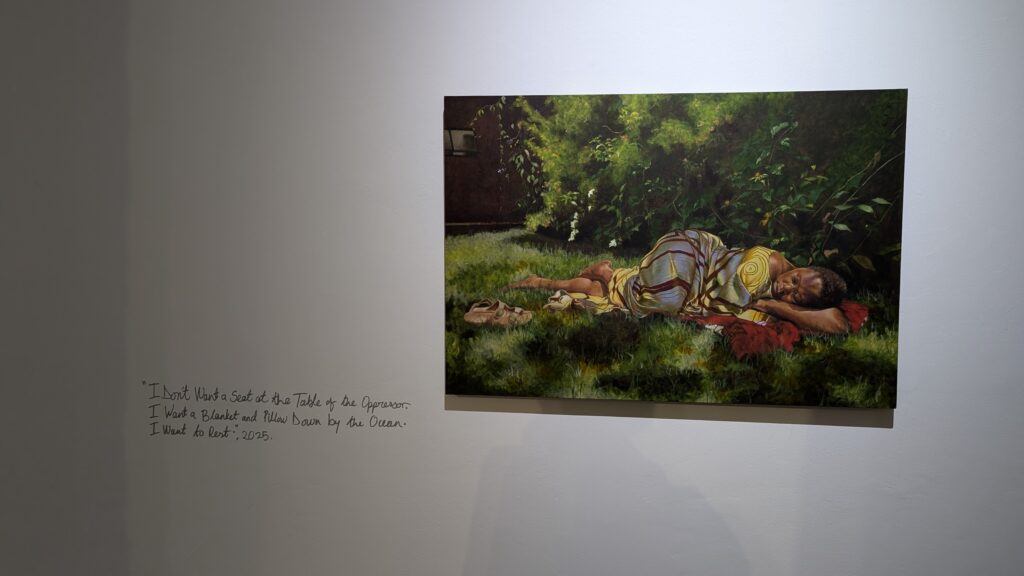
In another image we see the same woman apparently sleeping soundly on the grass in a private moment of rest. It is titled, “I Don’t Want a Seat at the Table of the Oppressor. I Want a Blanket and a Pillow Down By the Ocean. I Want to Rest.”, shifting a picture of peace to a quiet moment of protest, capturing the essence of the title of Tricia Hersey’s book Rest is Resistance.
Fabric of Our Being is an invitation to rethink rest as essential rather than indulgent. Kamunde’s works stitch together threads of identity and femininity, asking audiences to consider the socio-political facets of the dera and through this lens, offering a radical call to slow down, reflect, and reclaim space.
Fabric of Being is on at The African Arts Trust, Victoria Square, Riara Rd. through 2 August 2025