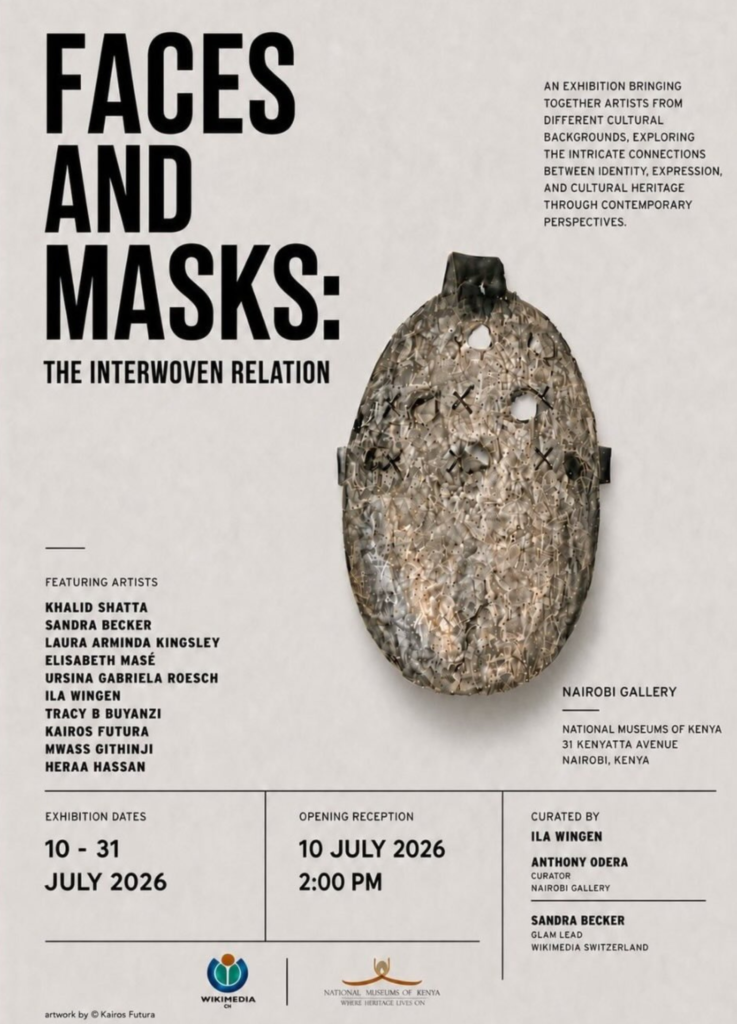


Faces & Masks: The Interwoven Relation explores the stories we inherit and the identities we create
Based at Nairobi Gallery, which houses over 10,000 archival materials collected from around Africa by former Vice President Joseph Murumbi, the exhibition brings together artists from Africa and Switzerland to respond to specific pieces from the collection, creating a dialogue between the past and present.
The historic collection spans Kenya, Cameroon, Côte d’Ivoire, the Democratic Republic of Congo and Mozambique, bringing together ceremonial masks once used in rites of passage, performance and communal ritual. Removed from their original contexts, they remain striking not simply because of their craftsmanship, but because they still carry a presence and embodiment of a pre-colonial history.
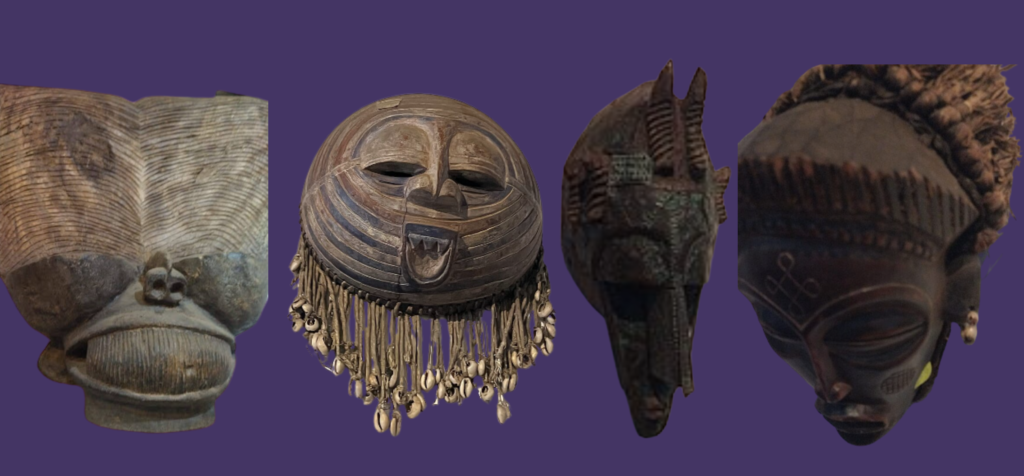
Masks from Murumbi Collection (L – R): Bamileke Sculpture, Cameroon (authority & chieftans), Wooden Moon Mask, Congo (significant in new moon dances), Baoule Ram Mask, Côte d’Ivoire (Akan people) (land and ancestral spiritual practices), Mukishi-Hamba Pwo, Mozambique & Congo (worn /performed by men to honor women),
This co-creation project between Wikimedia CH (Switzerland) and The Nairobi Gallery focuses on creative dialogue by bringing together artists from East Africa and Switzerland to shed new light on narratives anchored in cultural identity.
Long before it becomes an object in a museum display, a mask carries a life of its own, shaped by ceremony, performance, memory and belief. Each artist in the exhibition is responding to the respective cultural history of masks in their country, as well as that of the Murimbi Collection. The exhibitions curators aim to shed new light on the narratives anchored in cultural identity.
The project also explores cross-cultural perspectives between Switzerland and Africa. It is a collaboration of curator Ila Wingen, Rose Musyoki, the GLAM-team (Galleries, Libraries, Archives and Museums) Wikimedia Switzerland, with curatorial assistance from Anthony Odera of the Nairobi Gallery.
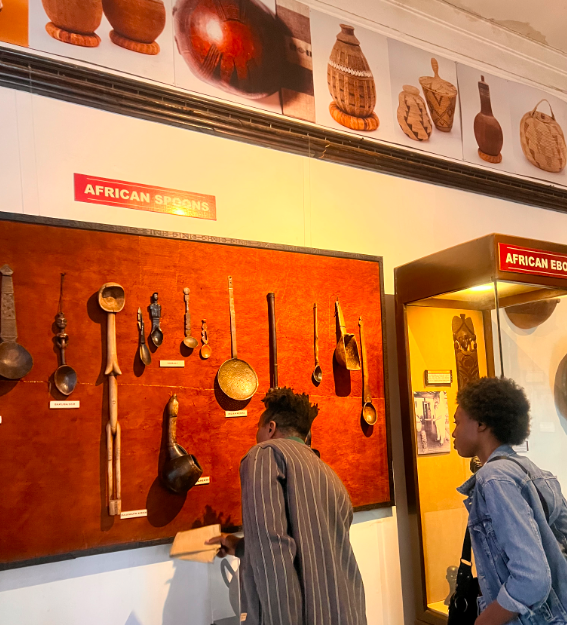
Artists visiting the Nairobi Gallery. Image via Wikimedia.
The project grew out of a week-long residency centred on oral storytelling and cultural exchange. Before making new work, the participating artists shared family histories, traditions and personal experiences of masks and ritual, allowing conversations to shape the creative process as much as the objects themselves. The result is an unfolding dialogue between people, places and generations.
The exhibition has used the gallery space at Nairobi Gallery in a unique way, completely utilizing the space in a way we have not seen in previous exhibitions.
Upon entering we are struck by a large, central piece by Tracy Buyanzi comprised of hanging fabric panels in the centre of the gallery; additionally, masks/helmets made by Kairos Futura, hang from the ceiling. Through these installations we have glimpses of wall based 2D works, visibly interspersed.
Rather than hanging flat against a wall, Buyanzi’s painted panels create a sort of passageway that visitors must enter, alluding to ritual space, where moving through the work becomes part of its meaning. The cloth is light, permeable and responsive to movement. As visitors pass through the installation, the panels sway gently, making the work feel alive. The body activates the piece; every encounter subtly alters its appearance.
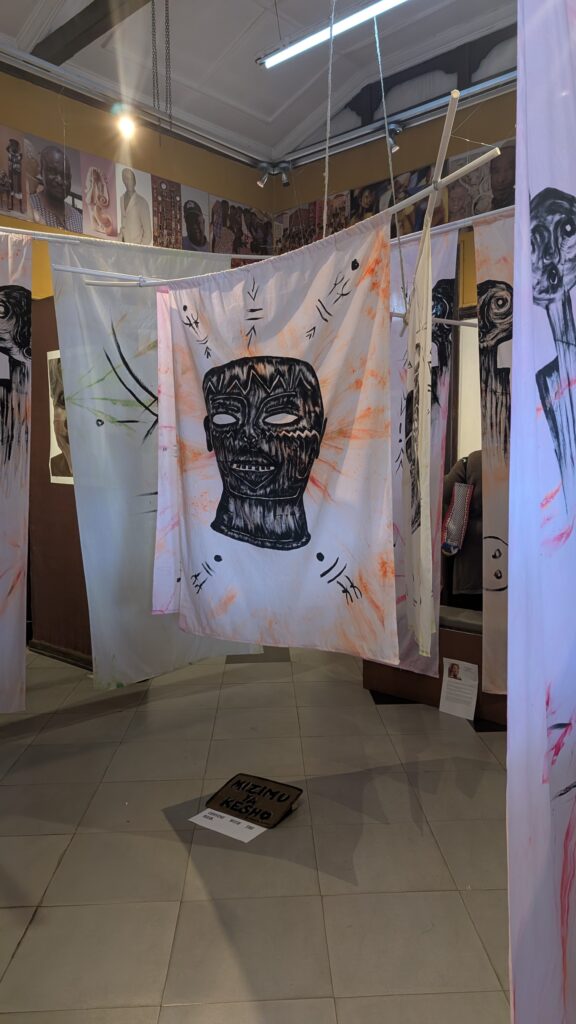
Installation by Tracy Buyanzi
At the centre of the installation is a striking abstract face painted in black, rendered with carved-looking geometric marks that immediately evoke African masks without directly reproducing any one tradition. The face occupies an ambiguous space between portrait and object: it is neither an individual nor a replica of a ceremonial mask, but an imagined presence that draws on a broader visual language of masking.
Surrounding it are small symbols, motifs which seem to draw on Kemitic and Cushitic symbols, are scattered across the fabric. Loose pink and orange washes across the fabric contrast with the heavy black marks, introducing a sense of energy or movement around the otherwise static face.
The reverse side of the installation reveals another visual register. Enlarged black forms, resembling eyes, seeds or stylised heads, repeat vertically across the cloth. Seen close-up, these motifs lose the legibility of the central mask and become abstract signs, moving between recognition and ambiguity.
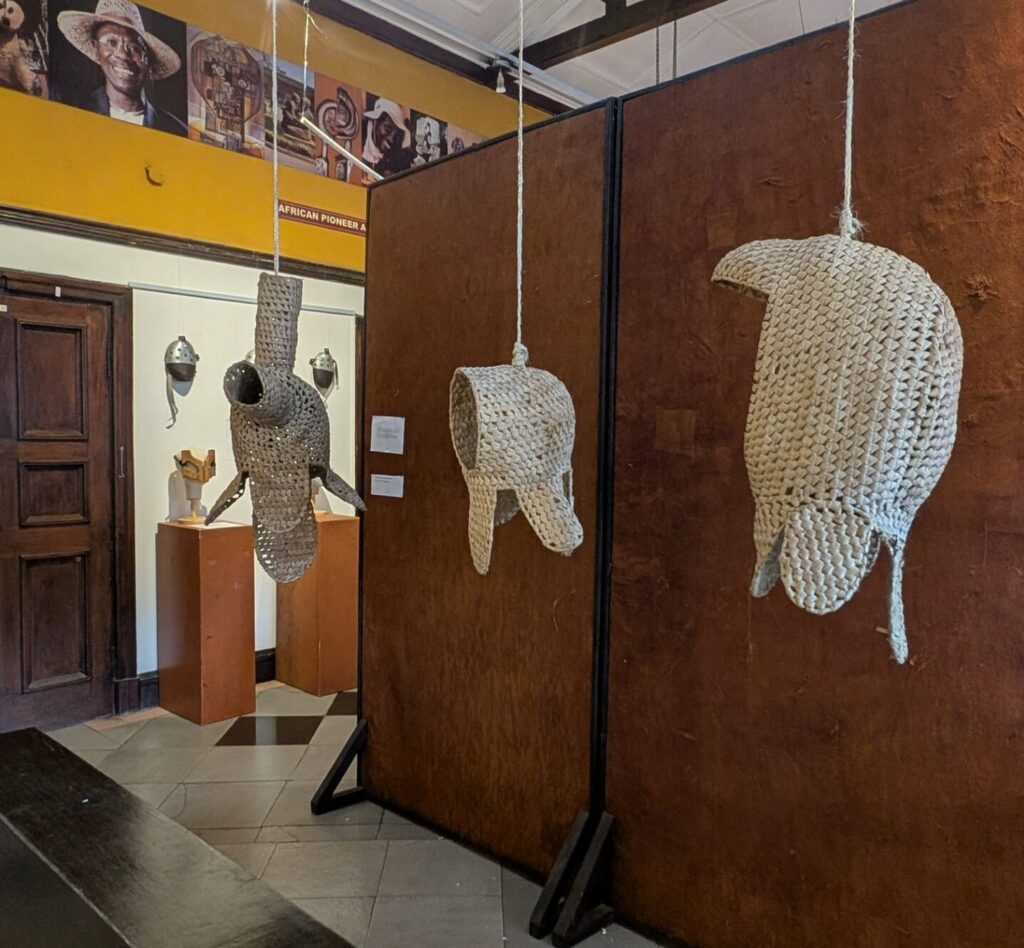
Lamu Space Station Masks by Kairos Futura
The headpieces by Kairos Futura are woven from natural plant materials and address the serious ecological threats, particularly ocean pollution, beach waste, and habitat degradation, that Lamu faces, thus bringing the ancient practice of mask-making into the arena of current eco-political concerns. The masks echo helmets of astronauts, commenting on the idea that humans could simply escape the habitation ruin of Earth by colonizing other planets.
For Kenyan artist Mwass Githinji, whose work frequently draws on folklore, mythology and spirituality, the masks become companions in an ongoing exploration of transformation and identity. Githinji’s spectral figures blur the boundaries between child, ancestor and mythical being. His masks are not costumes but psychological landscapes, where multiple faces, watchful eyes and hybrid forms suggest that identity is shaped as much by memory and imagination as by physical appearance.
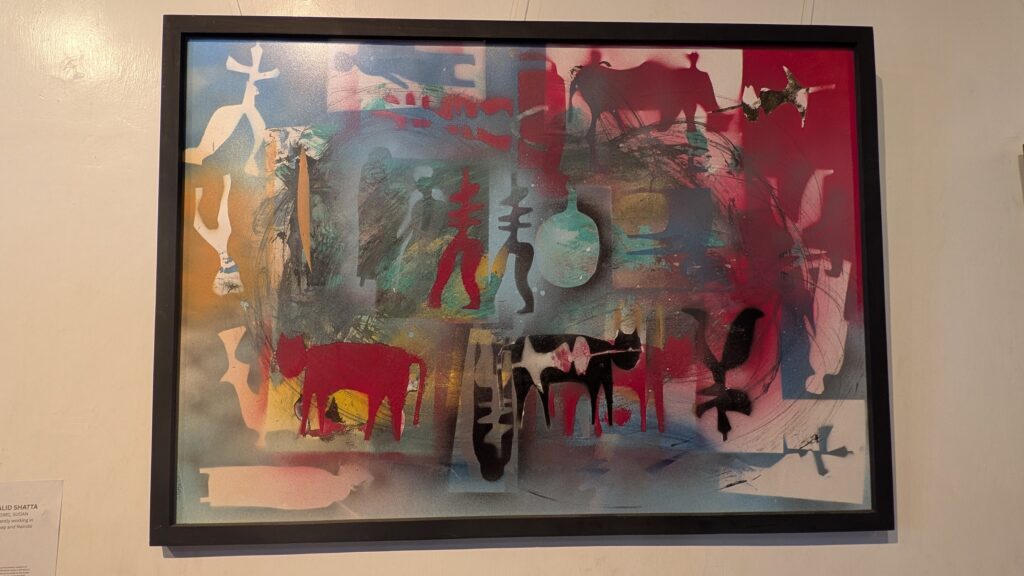
“God in Action (6)” – Khalid Shatta
Sculptor Heraa Hassan approaches the concept through material and form, creating works that echo the body’s relationship with memory and belonging through tactile forms that consider the body as a vessel and a keeper of cultural memories, while Khalid Shatta’s (Norwegian–Sudanese) works explore the intimate connection between humans and nature, employing geometric abstraction and incorporating ancient Kemetic and Cushitic symbols from the historical Nile valley civilizations to challenge dominant media narratives about Sudan and to celebrate indigenous systems of knowledge.
Juxtaposed against these visceral works are slicker feeling photo and video works brought by the European contributors, which can be glimpsed from betweent the flowing panels of Buyanzi’s installation.
Laura Arminda Kingsley is an American-born Dominican artist based in Switzerland, who has shown in Nairobi previously. Her work draws on evolutionary biology, deep time, microbiology, and diasporic mythologies. In this exhibition, she presents a video of herself literally donning, and removing, a three-dimensional mask, reminiscent of masks from both medieval Europe and South American civilizations. As Kingsley has said of her other works, she “challenge[s] the common question “Where are you from?” by shifting the focus to a much deeper and more relevant inquiry: “Where do we come from?”. The work also seems to refer to the psychological masks we wear every day throughout social interactions. She creates work that resists the notion of separation from those historically othered by colonial ideology.

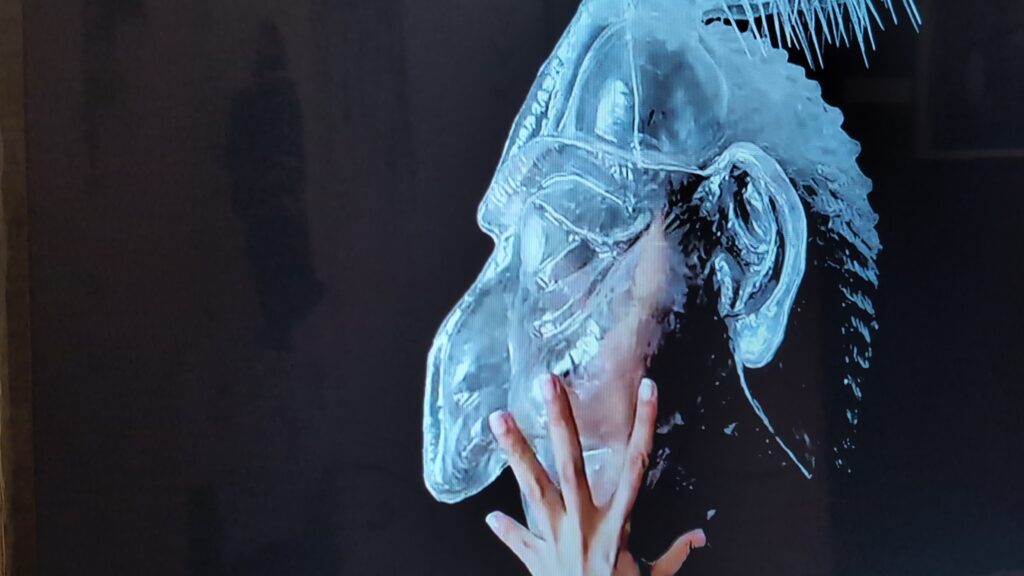
“She-Devil IV” – Laura Arminda Kingsley
A piece by exhibition curator Ila Wengen plays with the tension between portraiture and masking. Instead of using a physical mask, she employs fragmentation and erasure. At first glance, you recognise a face. Then, almost immediately, it begins to disappear. The bright yellow geometric shape acts like a mask, obscuring most of the portrait beneath it. Only one eye – which seems to be the emotional centrepiece of the work – looks directly back at the viewer. The lower half of the face dissolves into torn geometric fragments that suggest a mouth, but never fully resolve into one. Rather than presenting identity as something stable, the work suggests it is always incomplete or shifting. The portrait looks at us while simultaneously refusing to reveal itself.
Ursina Gabriela Roesch turns the cosmetic face mask into a contemporary ritual of concealment. Her piercing self-portraits are at once humorous and unsettling, asking where the face ends and the mask begins, and whether identity is something revealed or carefully performed.
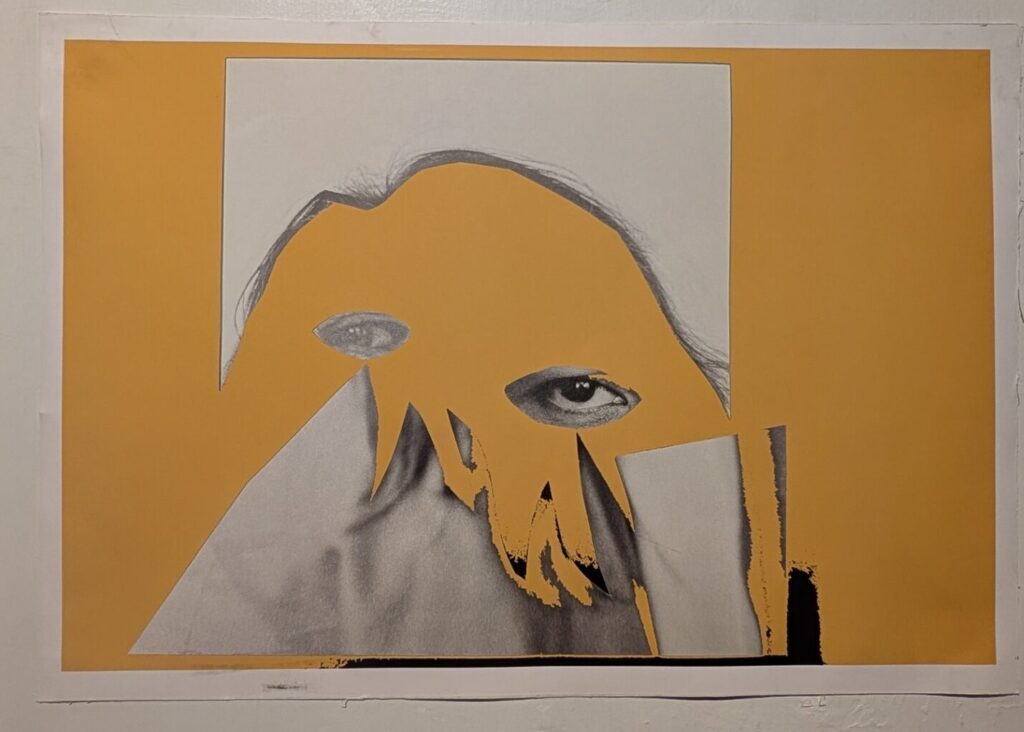
By Ina Wengen
Sandra Becker layers childhood memory with contemporary self-portraiture, using a Venetian mask to explore identity as performance. By placing an unmasked child beside a masked adult, she turns the photograph into a meditation on memory, self-fashioning and the many faces we inhabit.
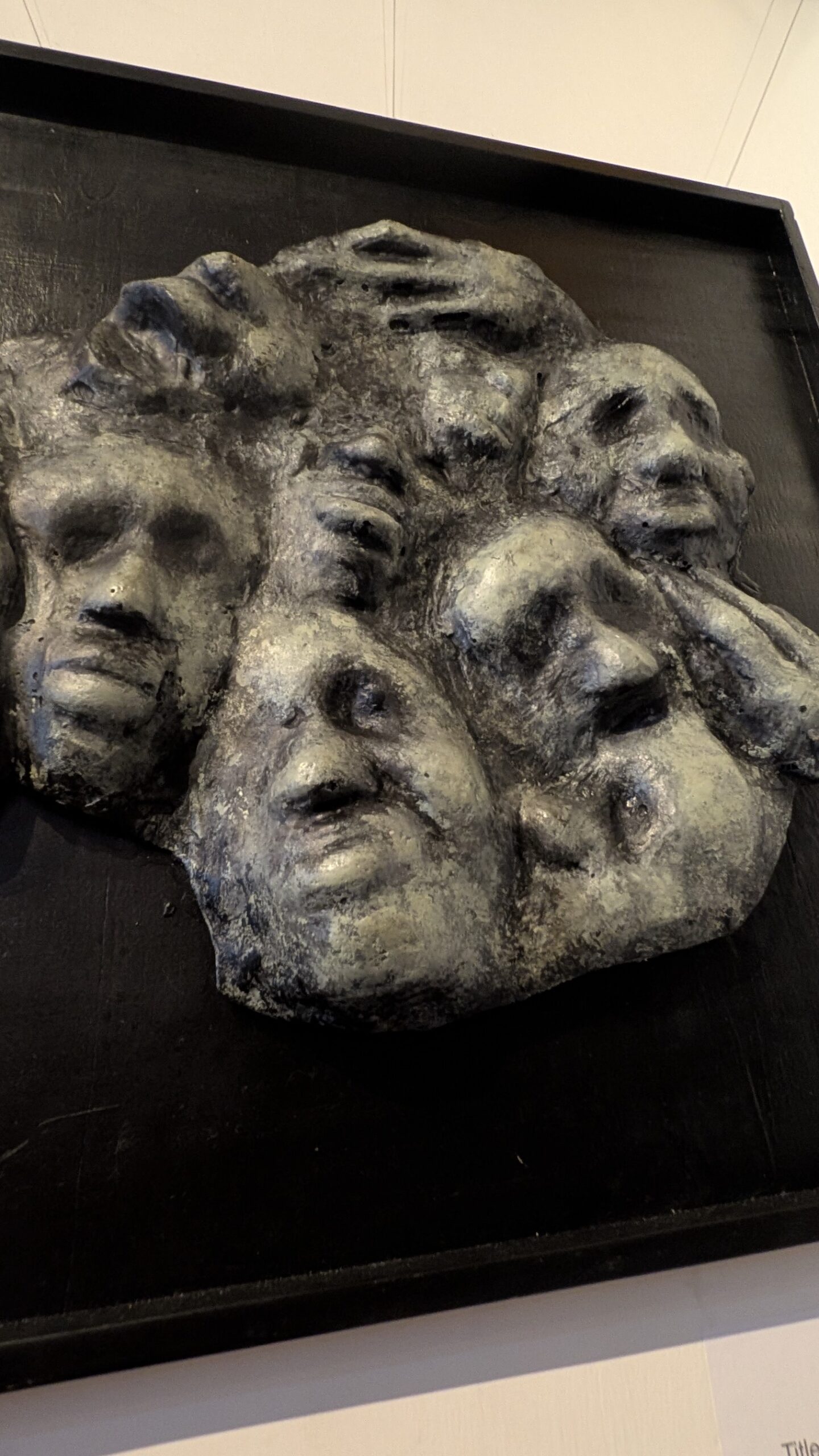
The four monochromatic figures presented by Elizabeth Masé blur the boundaries between human, animal and imagined beings. Elongated heads, multiple faces and fragmented bodies suggest identities that are fluid rather than fixed, echoing the exhibition’s exploration of the masks people wear, whether inherited, performed or imposed.
The multiple responses to the works of the Murimbi Collection shown in Faces & Masks reminds us that heritage is never static. While we find masks of a sort universally across world cultures, the roles they play may differ, historically and contemporaneously. Historically, masks transformed identity. They allowed someone to become an ancestor, a spirit, or another social role.
Here, masking becomes psychological rather than ritualistic. The works asks: What do we choose to reveal? What remains hidden? Is our identity ever completely visible?
These artists have interrogated these roles as well as the history and human embeddedness of mask. In this intelligent exhibition, the artists have demonstrated that meaning and interpretation of heritage and heritage items shifts with every generation willing to ask new questions of the past.
Faces & Masks: The Interwoven Relation | Nairobi Gallery | Through 31 July