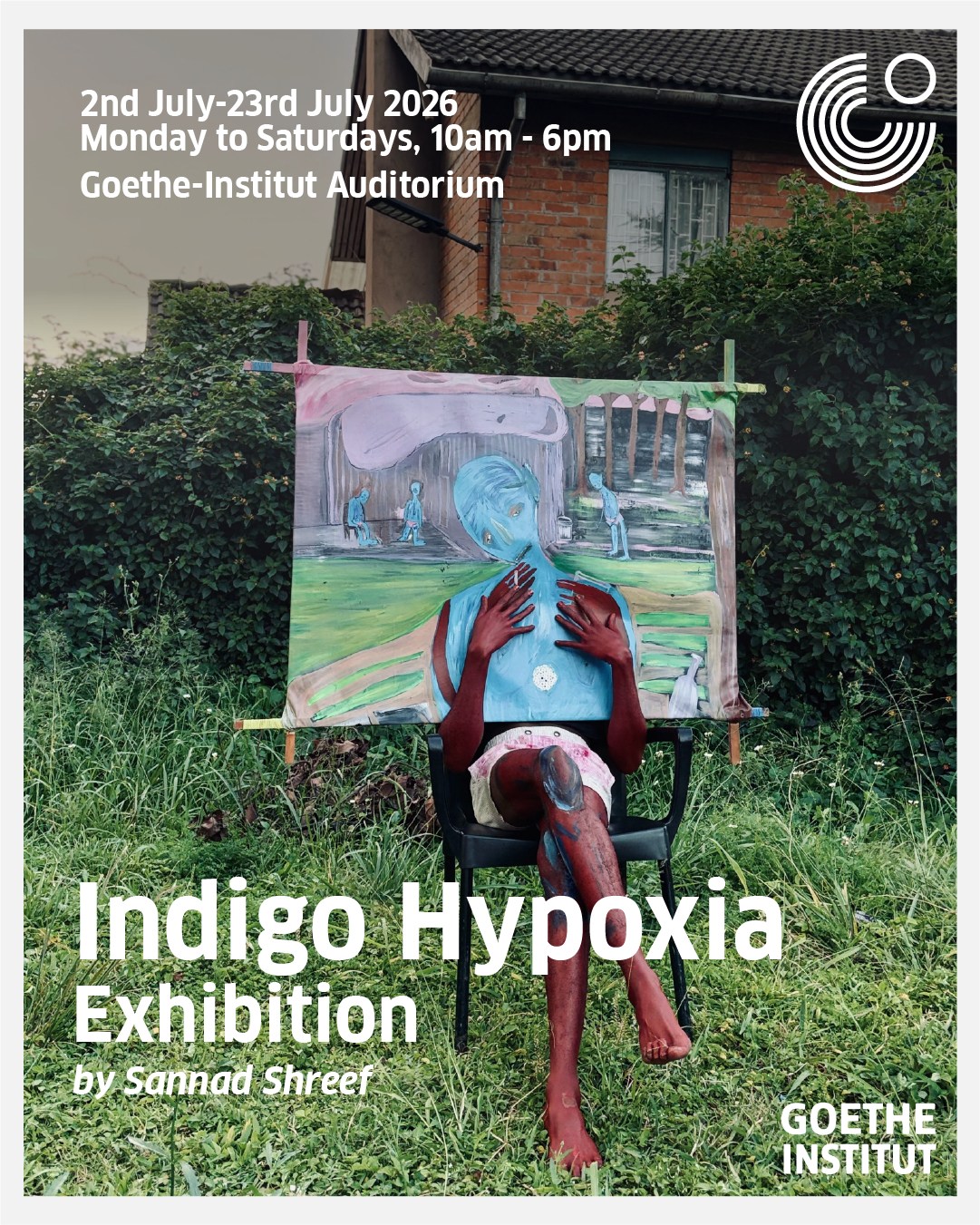


The first thing that Sannad Shreef told me upon meeting me at his current exhibition at the Goethe Institut is that he doesn’t think about his work, either before or after creation. He starts without a plan, going where the brush takes him. Once he has finished, the work is behind him and he is on to the next. His painting is very unconscious, coming from his subconscious. The only thing he can say about his process is that he is happy when he is making work. Interpretation he leaves to the viewer and whatever lens they might bring to it; he feels that art is about opening a space where the viewer’s own story can emerge, via the artwork.
My work is an instinctive conversation between myself, the materials, and the moment. I do not plan what I will paint or sculpt – the brush moves first, the colours arrive on their own, and I follow”
However, Shreef has consistently stated that his work centres on displacement, loss and transformation. Coming from Khartoum, Shreef lost everything in the current conflict, including his home, his studio and his artworks; even his family and friends scattered to different countries. Here in Nairobi he has been pushed to create with whatever has been available, “reaffirming that art can grow from scarcity”.
What makes Shreef’s work so compelling is that it communicates via atmosphere rather than narrative. While Shreef states that his work is related to conflict, he doesn’t represent conflict directly, Instead using imagery to embody emotional and psychological landscapes born out of his lived experience of conflict and displacement. He employs recurring visual motifs, exploring memory, grief, and the psychological spaces created by conflict. He paints what conflict feels like after the event: the lingering psychological weight, the instability of identity, and the fragile persistence of hope.
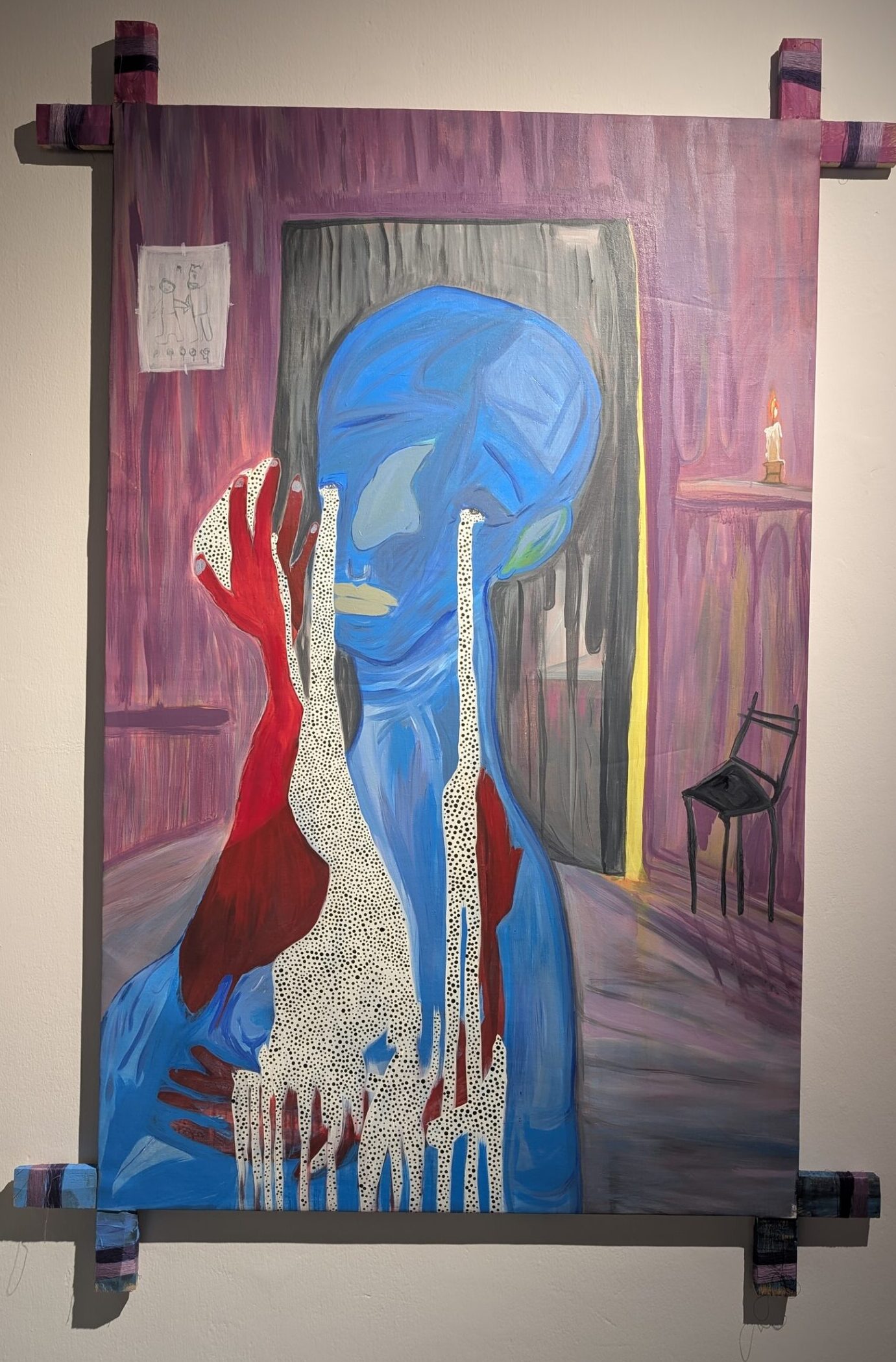
Shreef told me that he associates the colour blue – seen in all his works in this exhibition and referred to in the title Indigo Hypoxia – with sadness. The most recognizable motif in Shreef’s artwork are the elongated, alien-like figures, in this case painted in blue. And all of his bright blue figures do indeed look melancholy and thoughtful, as if in a long-lasting, reflective state of low spirits, woven with introspection.
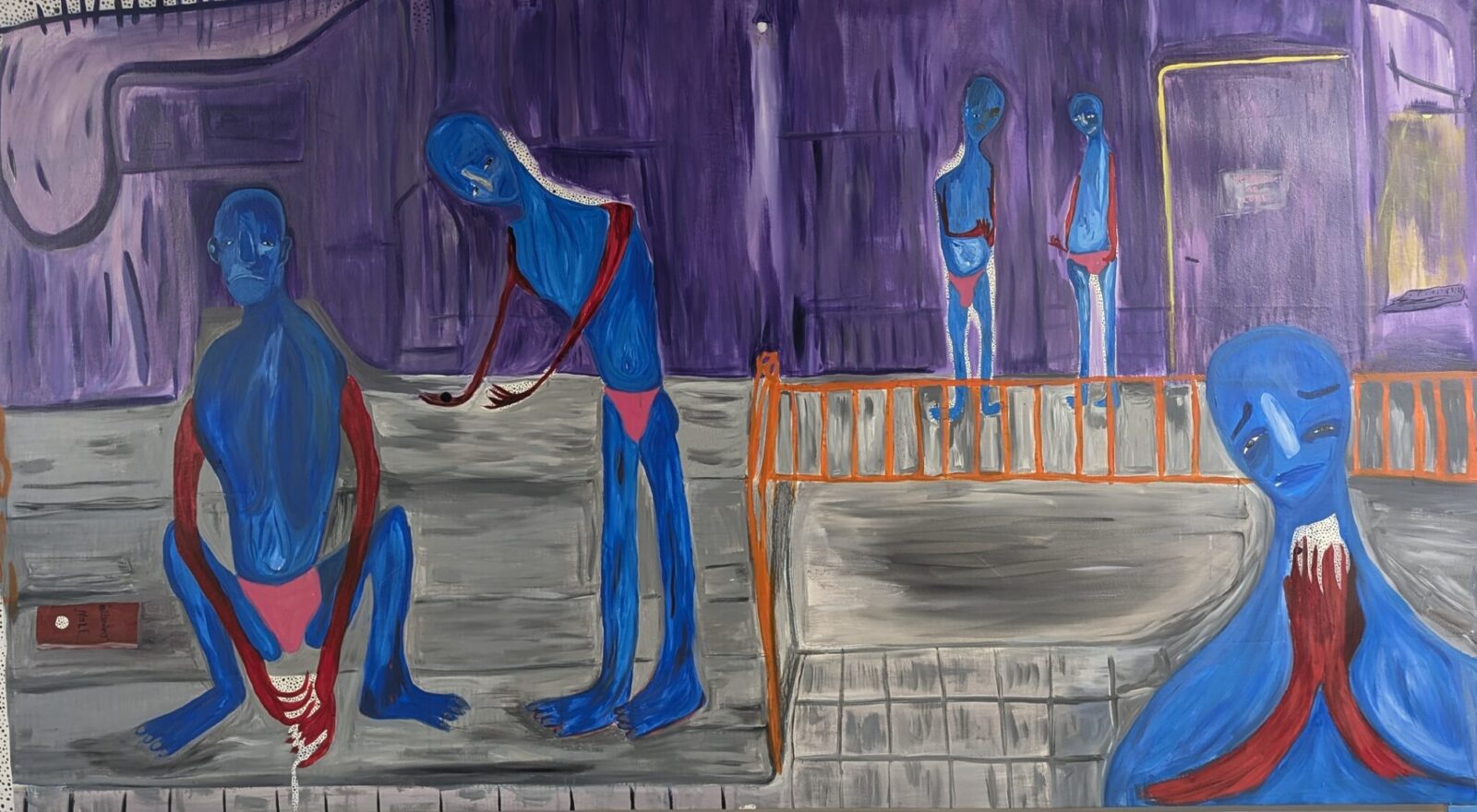
The figures are depicted in a way that they appear to be melting, or dissolving, or collapsing. They are long and liquid feeling. They are positioned against a purple background, representing a spatial and emotional void. Through his visual language, Shreef asks: How does it feel to experience sadness, yet be in a void?
The striking blue figures don’t wear any clothes apart from a bright red pair of pants, which coordinate with their talon-fingered red arms. They look slightly alien. Some figures cry tears comprised of Shreef’s signature black-dots-on-white-background pattern.
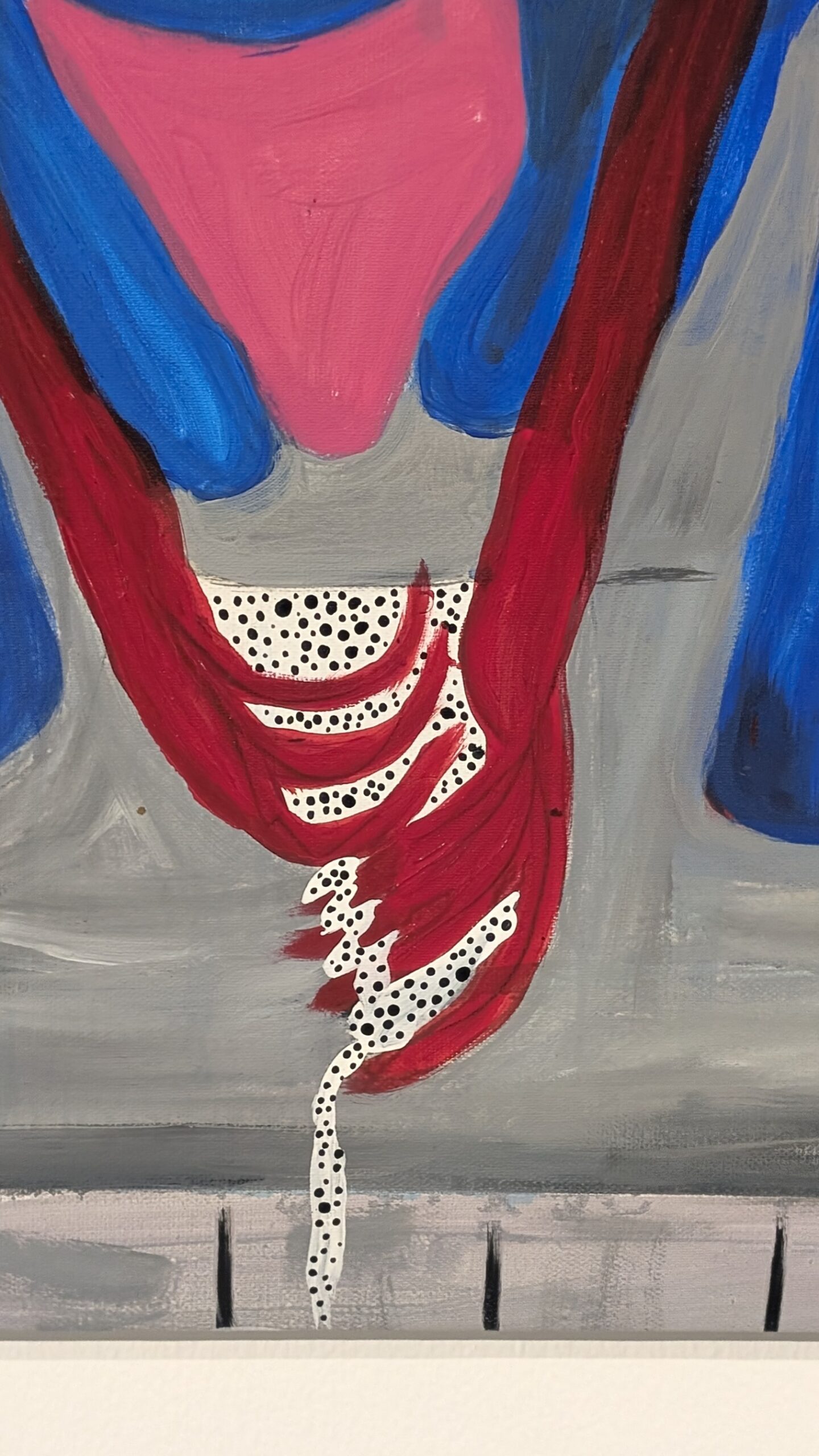
Detail “Remember to Hope”
Shreef has described the dotted pattern as condensed traces of memory and grief that cling to bodies, interrupt surfaces and spread through space. As such, we can interpret these tears as those of grief and lived trauma. Throughout the works in this exhibition we can see figures crying and otherwise manipulating these symbols.
The dots are not uniform in either size or arrangement on the white field. In some work, particularly “Die For You”, the dots can be seen to represent the tension between order and chaos. “Die For You” might be interpreted as elements of figures floating peacefully in outer space, in a state of fugue. Or they might be blown up. Shreef chuckled when I posited the dual interpretations.
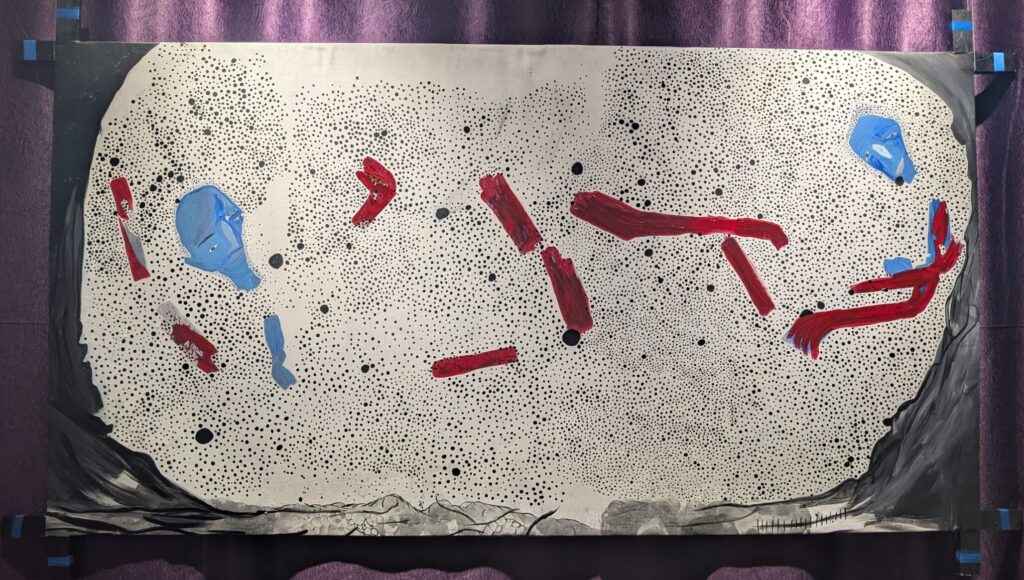
“Die For You”
Shreef has a very expressionistic brush stroke with some paintings distinctly bringing Van Gogh to mind, particularly the piece “The Past Won’t Leave the Room”, where a rickety chair stands alone, and significantly empty, in the corner of the purple room, while a large blue figure weeps in the foreground. The whole painting seems to embody loneliness.
”Remember to Love” presents a tableau in which the figures look dystopian, lingering in a cityscape of some sort. One man squeezes something into the gutter with long tapering blood-red fingers. Whatever is being squeezed has the same dotted black-on-white pattern that we see in other works. As if he is squeezing the tears of the other paintings’ characters into the gutter.
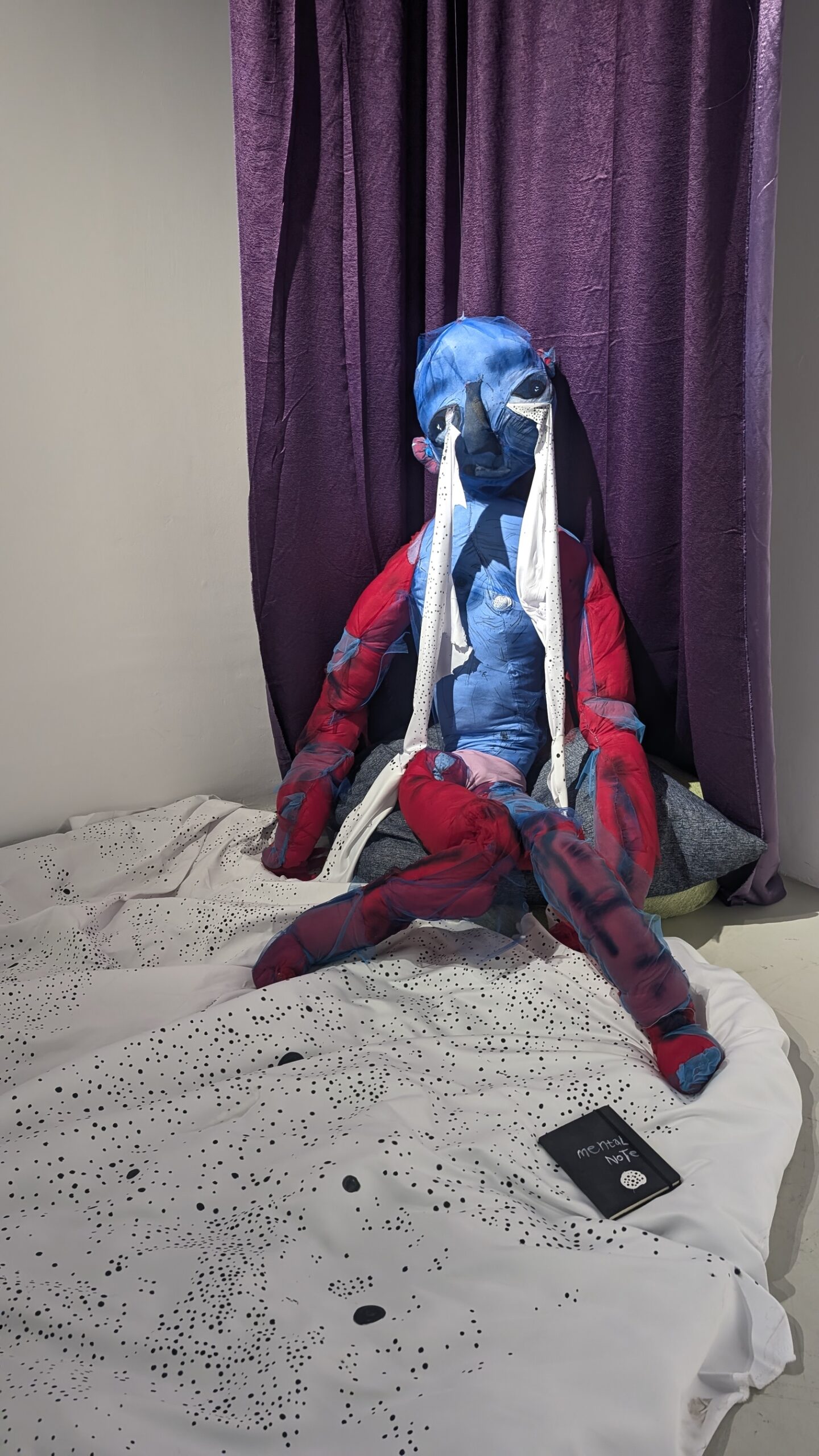
Shreef is also “drawn to materials that carry a sense of touch and memory: fabric, thread, cotton, and metal”. In this exhibition we see a larger than life doll-like human figure. Blue, of course, crying dot-patterned tears, slumped in a corner of the room. It has a dot-patterned ball embedded in the centre of its chest, and sits on a sheet of dot-patterned cloth. If any piece in the exhibition looks like an image of conflict, this is it.
I try to capture what the eyes cannot say, but what the spirit leaves behind”

We need to consider the title of the exhibition: Hypoxia is a dangerous medical condition where the body’s tissues and organs do not receive enough oxygen to function properly. In the context of the mind, hypoxia represents an emotional or intellectual “suffocation.” An environment that lacks necessary resources, support, or freedom can be described as emotionally hypoxic – leading to creative stifling, burnout, and a sense of suffocating under the weight of pressure.
“Blu Face”
Yet Shreef has not been creatively stifled, even if he might be feeling the suffocation of trauma and the burnout of being resilient. He has used artistic expression as a channel for his traumatic experiences. While still in Khartoum, at the outbreak of the war, Shreef also used his art as an act of defiance, carrying artworks through the streets. His social media shows videos of these acts, with the sound of gunfire in the background.
Despite the melancholy feeling of the works, for Shreef, the pieces also represent hope and resilience. Painted subtly into the background imagery of the dystopian, urban tableau, like a note on a wall, is the painting’s title: “Remember to Love”, an exhortation of hope.
Sannad Shreef (b. 1990, Doha, Qatar) is a Sudanese visual artist based in Nairobi. He grew up in an artistic environment, spending much of his early life in his father’s studio, where he began experimenting with painting, sculpture, and live performance.
Indigo Hypoxia is at Goethe-Institut until 23 July.