

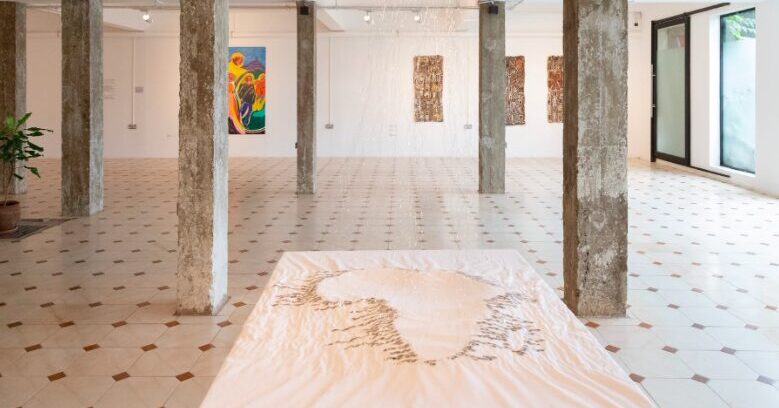

Nine artists explore resonance, heritage, and ecological consciousness in an exhibition at Heltz House, Ngara.
It Resonates features work by nine visual artists from across Africa. The exhibition explores how issues related to climate change and the degradation of the environment subtly infuse artists’ work. As we all know, although Africa is the world’s least polluting continent it is one of the most affected by the impact of climate change and environmental degradation. We have certainly seen this in Kenya with prolonged country-wide drought, followed by extreme rains and changing weather patterns.
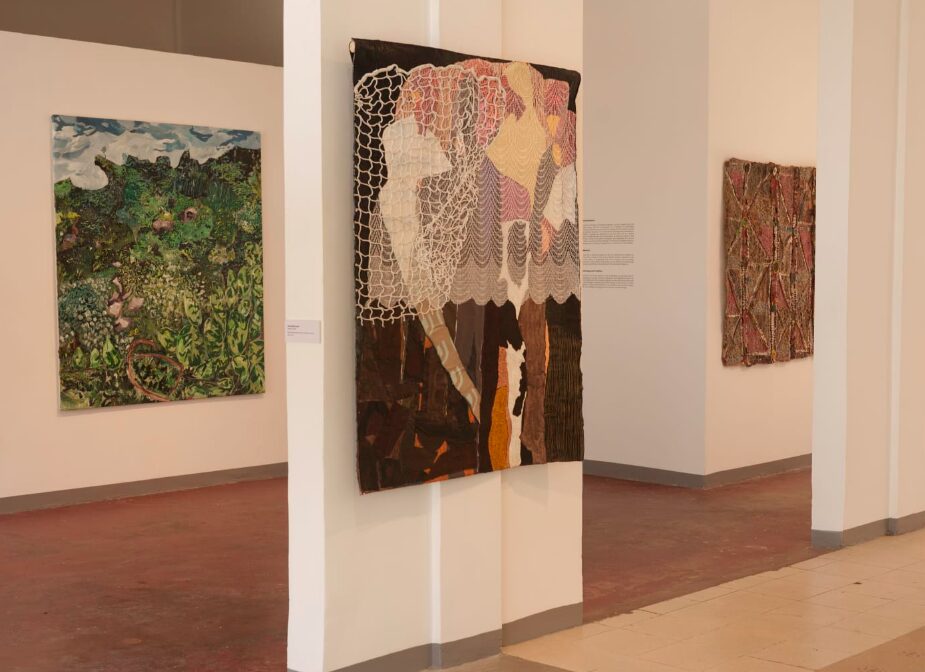
Exhibition view showing works by Martin Jakaila, Collin Sekajugo and Temandrota
The exhibition draws on the concept of “resonance” – the charged interplay where self and world affect one another – as per German philosopher Hartmut Rosa. The artworks here do not dramatize climate disaster. Instead, they probe our connective tissue with the planet, weaving awareness through metaphor, memory, and abstraction. In this non-confronting way, there is a soft insistence that we listen, that we shift, that we remember ourselves as part of a network.
Each of the nine artists addresses the topic in their own nuanced way. None of the works are images of catastrophe, but represent the artists’ explorations of connection and transformation that foster various forms of resilience. In Rosa’s terms, resonance dissolves hierarchy: humans do not sit above the world, but within it. In “It Resonates,” the works gesture toward reciprocity: how land shapes us, how history alters soil, how our gestures affect the non-human.
The artists’ geographies, languages and media are diverse. Yet together they form a balanced counterpoint, a polyphony of resonance.
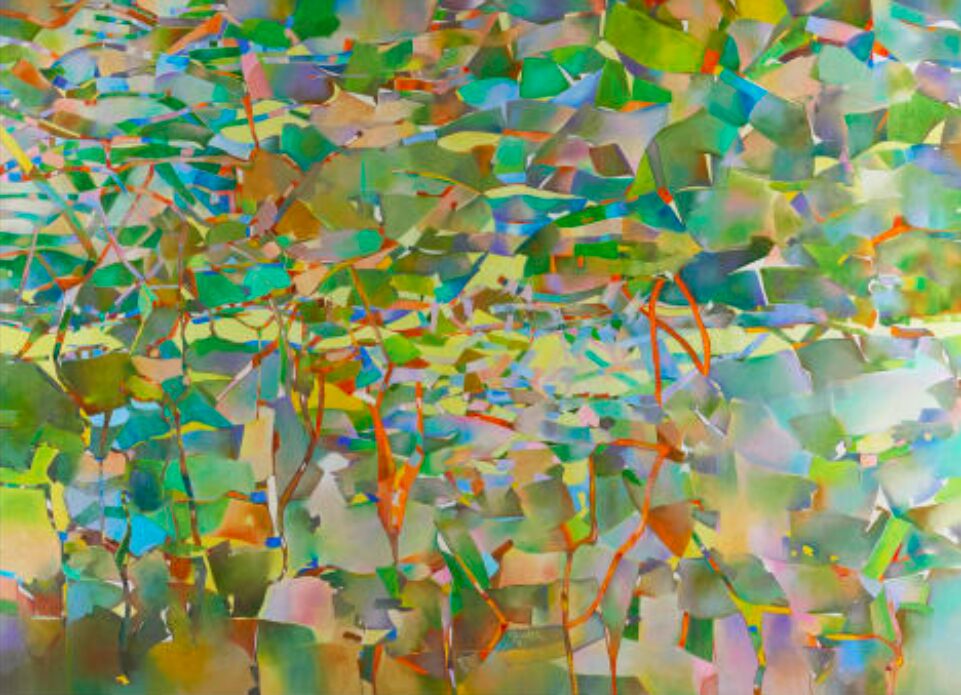
Dawn, Joseph Ntensibe. Image courtesy of 50 GOLDBORNE
Martin Jakaila’s (Kenya) lush landscapes are the first images encountered on entering the gallery, drawing the eye into layers of color and texture, with an invitation to peer behind surface into the memories of childhood upcountry.
Joseph Ntensibe (Uganda) also works with “forest-scapes” that depict the dramatic deforestation he witnessed in his homeland since childhood. Through his art, he uses color, brushstroke, and composition to convey the vibrancy of forest ecosystems and to raise awareness about the urgent need for their protection from environmental threats like mining, war, and urbanization. His use of colour, brushstrokes and compositions expressively illustrate the life of these precious ecosystems.
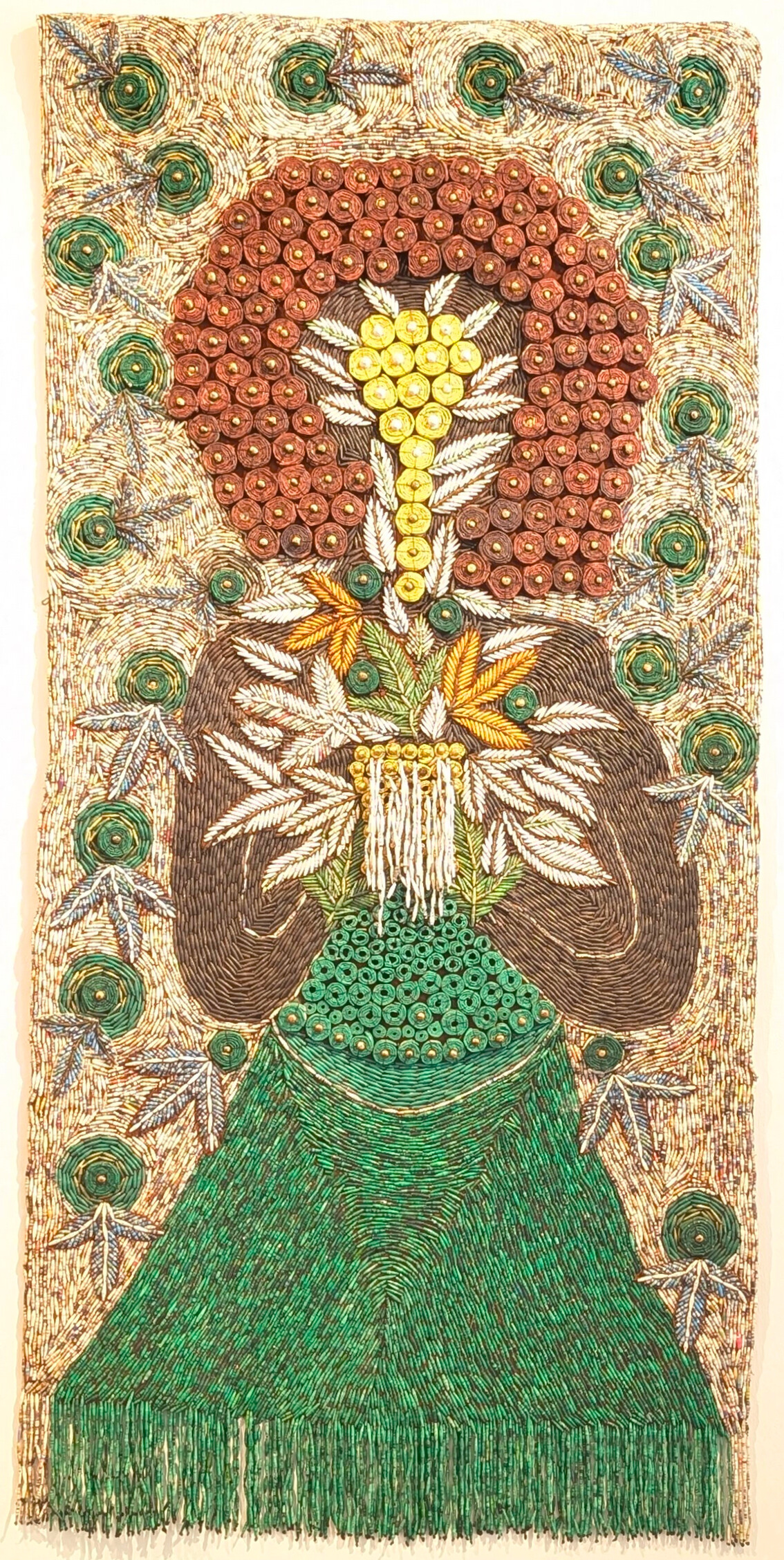
Maid of Honour, Sanaa Gateja. Photo by author.
The connection between self and planet is tangibly manifest in the materials used by Sanaa Gateja (Uganda) and Temandrota (Madagascar). The works of Sanaa Gateja are striking in their haptic quality, which you discover as you draw closer to the works. His soft wall-based sculptures are composed of hundreds of handmade paper beads – Gategja links them back to their origin within trees – that are stitched one by one onto bark cloth, lending a deep textural quality to the works. The paper is reclaimed from newspapers, magazines, and other paper products, with glimpses of words evoking the white noise of the constant input of information we receive daily. Gateja works with women in his local Ugandan communities and positions his work as representative of traditional East African values.
In his travels across Madagascar, Temandrota has intentionally gathered natural materials – earth sap, rainwater and pigments – in the tradition of the Tandroy people of Southeast Madagascar—with whom he was raised as a child. Temandrota’s works mirror the ancient strategy game Fandron Tsivy, with geometric grids created from earth, sap, raffia, cane, recycled flip-flops, and acrylic paint. Each work contrasts a lush forest with the same landscape after deforestation, anchored by a mythological figure and scattered game pieces. The works comment on Madagascar’s environmental challenges, where communities, lacking alternatives, rely on charcoal from shrinking forests, highlighting the burden poorer nations face in mitigating emissions.
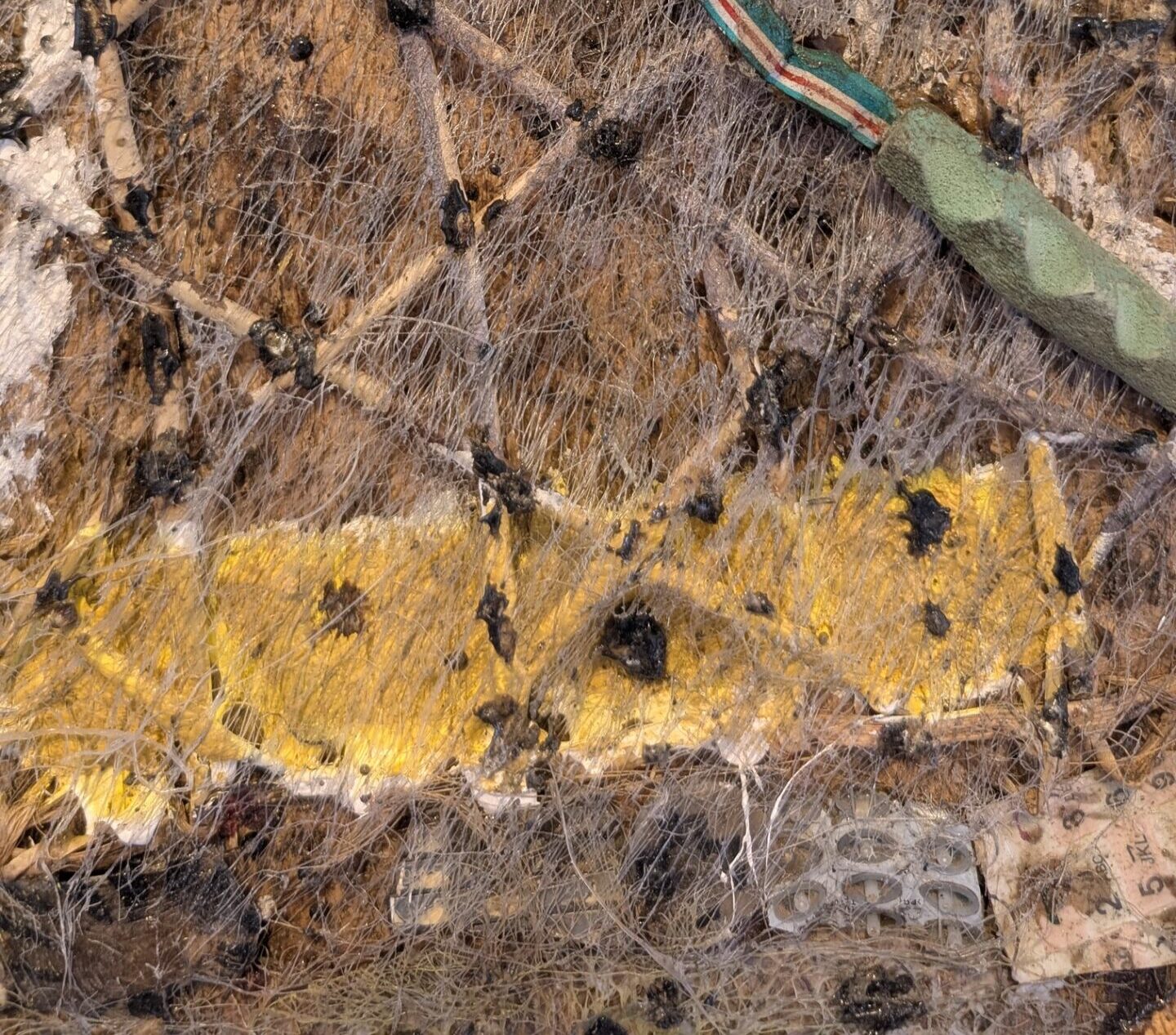
Detail from Temandrota’s Fanarona Slvy (Rouge et Jaune) – Photo by author
Like many of the works in the exhibition, Collin Sekajugo’s (Uganda/Rwanda) uses layering and multi-media, including bark cloth, to create texture within his works. Sekajugo’s pieces often thread political and ecological concerns, exploring themes of identity and multiculturalism alongside sustainability. In his works he has reclaimed fabrics commonly used in his communities to embed their narratives in his work while at the same time making a commitment to re-use.
Safaa Erruas (Morocco) uses meticulous, ritualized gestures to create installations and works on paper. In her installation piece The Continent diaphanous lines are tethered to miniscule eyes, forming the outline of the African continent. Textures tend toward the poetic, offering an archaeology of what the environment remembers. They point to a space between the visible and the invisible, consciousness and unconsciousness, gentleness and violence. Erruas’ work is dominated by the color white, which she says symbolizes absence, immateriality, transparency and fragility.
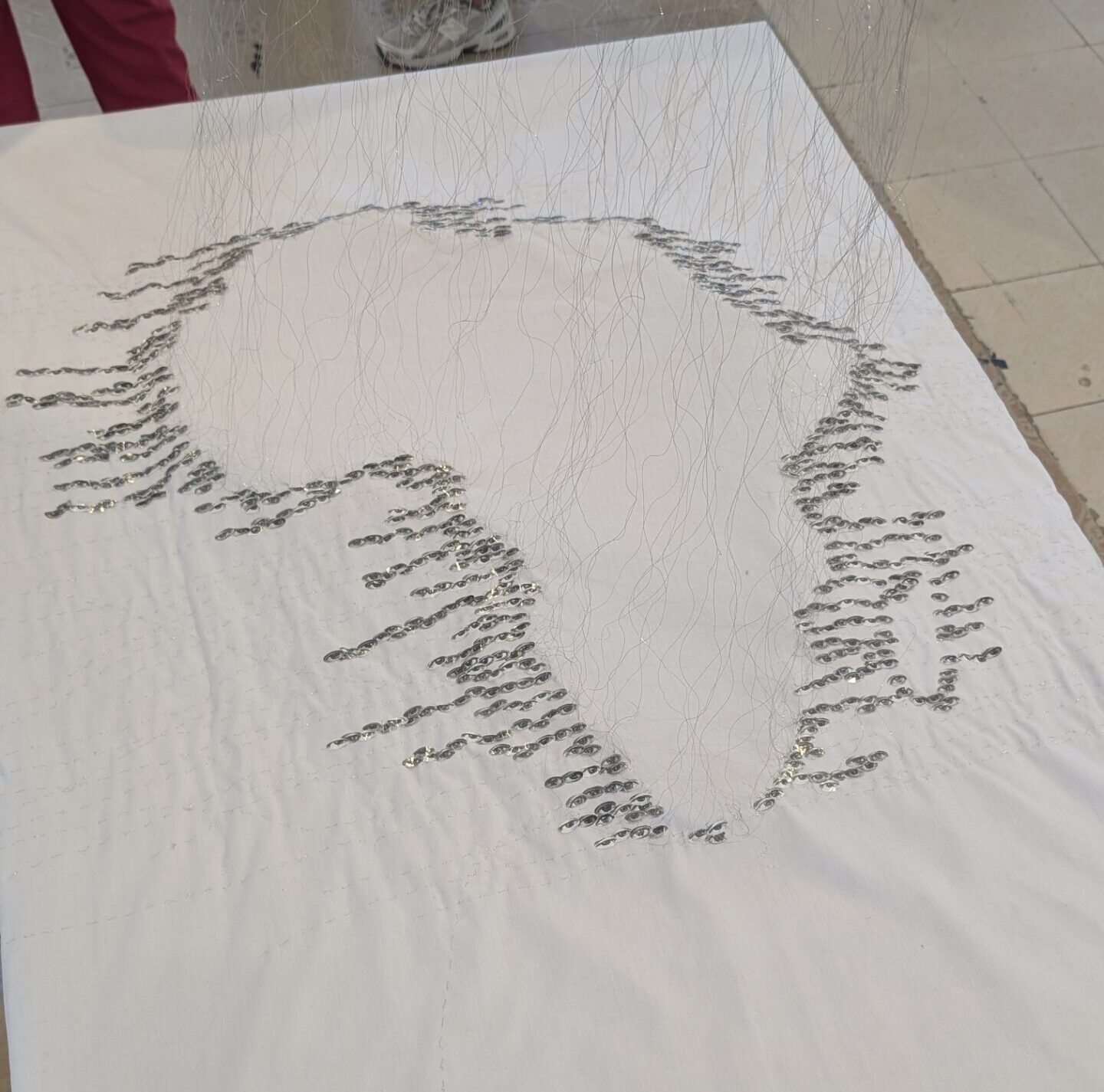
The Continent (installation view), Safaa Erruas. Photo by author.
Part of the pleasure of viewing works at the Heltz House is the vast space, allowing various angles of reflection as well as multiple rooms in which to explore the works.
After crossing the courtyard and entering another room we encounter Chemu Ng’ok‘s (Kenya) colourful, layered, process-based paintings. Her abstract figurative work delves into personal, psychological, political, and spiritual aspects of human connection and relationships, gesturing to collective acts of repair and of making, together.
In a final corner we find Emo de Medeiros (Benin/France) graphic fabric works, reminiscent of bed quilts but with strong, brightly coloured imagery of phoenix, intimating Africa’s rise from the flames of colonization.
Walking through the rooms, one senses shifts of tone: sometimes the feeling is brooding; elsewhere, calligraphic gestures shimmer like breathing. The conversation is not clamorous, but subtly sends its messages.

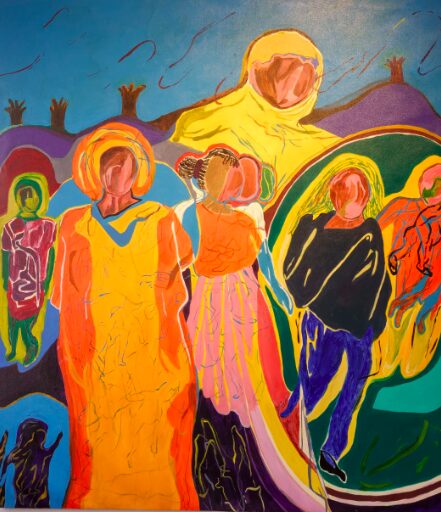
Creating / Community, Chemu N’gok. Image courtesy of 50 GOLDBORNE
The exhibition has been brought to Nairobi by London-based gallery 50 GOLBORNE. The gallery, which is celebrating its 10th anniversary this year, has been supporting the careers of artists of African origin globally. 50 GOLDBORNE founder Pascale Revert notes that they were drawn to Nairobi’s ambition: a city asserting itself as a collaborator in the life of contemporary African art. In a city already revealing strands of a green future – 80 percent of Kenya’s electricity comes from zero-carbon sources – It Resonates feels synchronous.
We look at African Contemporary Art beyond country borders… We are exhibiting in Nairobi to encourage a trans-Africa artistic dialogue…it is important for the gallery to exhibit in meaningful places.” – Pascale Revert.
Originally shown privately during the TED Countdown (Climate) Global Summit in Nairobi in June 2025, the exhibition is now open to the public in Nairobi’s developing Creative District in Ngara Road, near the Sarakasi Dome.
It Resonates | Heltz House, Ngara | Through Saturday 4 October, 11am – 6pm
The exhibition will conclude on Saturday 4 October with extended hours (11am – 9pm) and a pop up brunch with Kali Works from 10am – open to all.