


An Exhibition Review by Joy Odondi Mala
In Memory, Creation, and Writing, Toni Morrison observes that “Memory (the deliberate act of remembering) is a form of willed creation. It is not an effort to find out the way it really was—that is research. The point is to dwell on the way it appeared and why it appeared in that particular way”.
This ethos of willed creation permeates the recent work of James Vaulkhard. His solo exhibition, Recent Works, on view at Nairobi’s One-Off Contemporary Art Gallery, invites us into the planes of time that constitute his childhood memories and calls on us to dwell in the imprints left by the places that shaped him.
Among the most arresting pieces are the night paintings of his recollections of his visits to Msambweni beach on the south coast of Kenya. Painting on black and dark blue pastel paper and sometimes using a black oil stick on a wooden board to dominate the work, he collapses the constraints of his classical art training to allow an unfiltered remembering to pierce through. Dark, black night is what it is. In these nights untouched by our civilization’s need for bulbs and floodlights, we feel the light in the works more than we see it. Sometimes, using purple pastels, he darkens the night by mapping out the shadowy silhouette of the palm trees, allowing us a view of the moonlight streaking through them. Other times, he anchors our perception of the light on the bonfire erupting with streaks of red, oranges, and yellows, enticing us to both feel its warmth and dance in its silent yet raging aura, as some of his subjects are seen to indulge in.
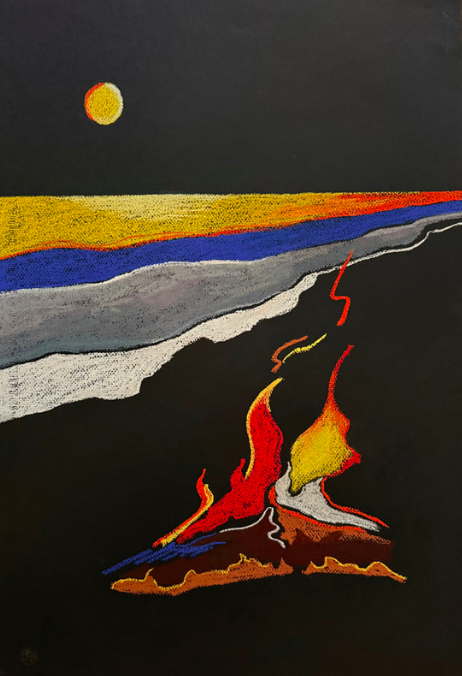
Msambweni I
Born in 1986 in Nairobi, James Vaulkhard spent a great portion of his days being consumed by the magnificent vastness of the outside. “I think one of my first memories of painting was at the animal orphanage at the Nairobi National Park”, he says. He would revisit these places, pondering his place within them, touching the peace that they exuded, and making visual shorthand of them in sketches. In a conversation, he mentioned how, for a long time, he found it difficult to paint Limuru. Known for the endless fields of green tea bushes, the Kericho and Limuru areas can indeed be a visual and mental treat while posing enormous challenges to the painter concerned with the unique stamp of a specific place. The challenge is akin to painting a specific point in the sea: how does one capture the unique stamp of a place when its overwhelming feature is its own uniformity?
In the gallery, these challenges read as a triumph because, painted in high contrast, the lush greens of Limuru bring us to a pause, slowing our gaze to halt at very specific spots known to him and capture what he has seen and held. He transfixes our senses with the very light greens highlighted in yellow hues that invoke the imagination of sunny days in Tigoni and reveals how places change and, at the same time, remain unchanged in time, depending on the people in them and modern pressures.
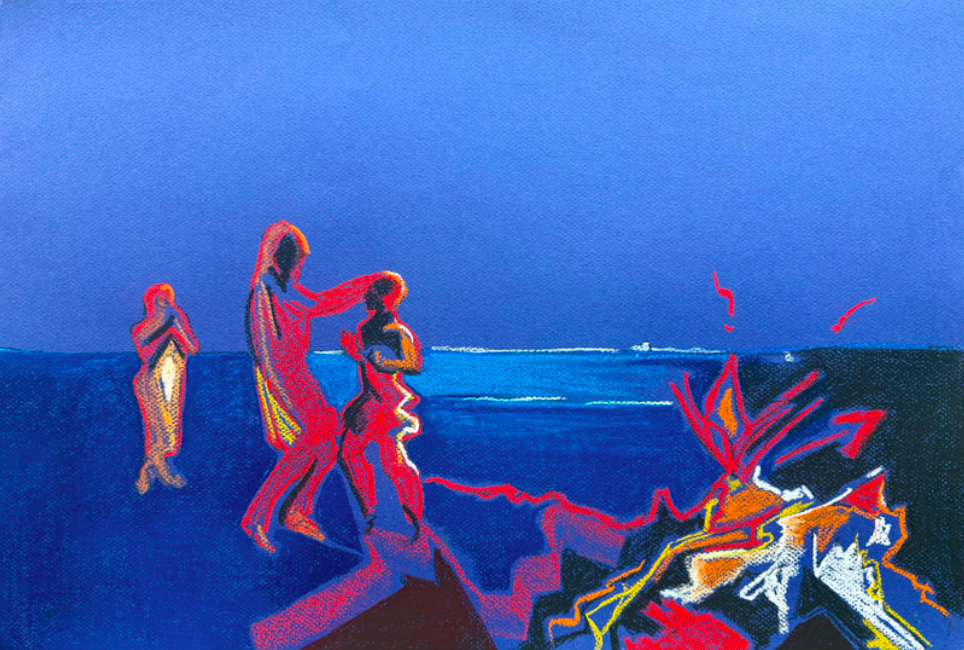
Msambweni II
At a time when the modern art world is heavily reliant on an artist’s identity to project core messaging in their practice, VAulkhard’s oeuvre is both research and a tool of experimentation. Vaulkhard had previously exhibited a body of collage works of seven representations of James Bond using cutouts of erotic and porn imagery, a collage portrait of Donald Trump made from cuttings of historical dictators, and ‘Faces of a Monarch’, a collage portrait of Queen Elizabeth made of cutouts of pictures of her over time. Also among his recent exhibits were some algorithm-inspired cave paintings made to evoke questions on human identity, and in another show, diverse landscape works from a 5000-mile journey across the American landscape.
In this current exhibition, he continues with the evocative and nostalgic landscape preoccupations with an even greater play on abstraction. Only chosen to present the scenes in Kenya, the works feel like a silent witness to his past as well as an encounter with his dreamscapes; rendered in loose colouring with spaces meant to show the bare paper as shadows, use of a few but vibrant colours, and simple lines and forms to articulate entire scenarios.
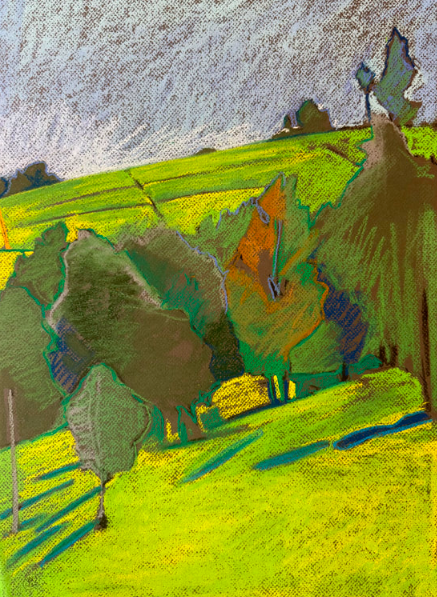


Maramba II
“Painting the scenarios” is what someone once remarked when he found Vaulkhard painting outside, and rightfully so, that was it. Vaulkhard’s work converses with the legacies of Richard Diebenkorn and Clyfford Still, yet his voice is distinctly his own. His palette is less a record of light and form than an articulation of memory itself. Moving from the slow-drying impediment of oils to the immediacy of chalk, pastels, and oil sticks, Vaulkhard works with speed and intuition and on several pieces at a time. Following in the footsteps of the Hudson River School, he uses his expressionist abstraction method not to paint what he sees, but the feeling of being in the moment or encountering a place.
James Vaulkhard’s artistic language, now leaning into abstraction, is deeply informed by a rigorous formal education. He holds a BA in Art History from Leeds University and has both trained and taught at Charles Cecil Studios and Studio Della Statua in Florence, where he built a formidable reputation in traditional portraiture and sculpture. This foundational discipline is what allows him to so effectively deconstruct it, bringing a master draughtsman’s understanding to his evocative “scenarios”. His practice has also extended into significant collaborative projects, such as his contribution to the bridge project between Italy and Kenya, for which he developed preliminary studies for the Sacred Heart Cathedral in Kericho in 2013.
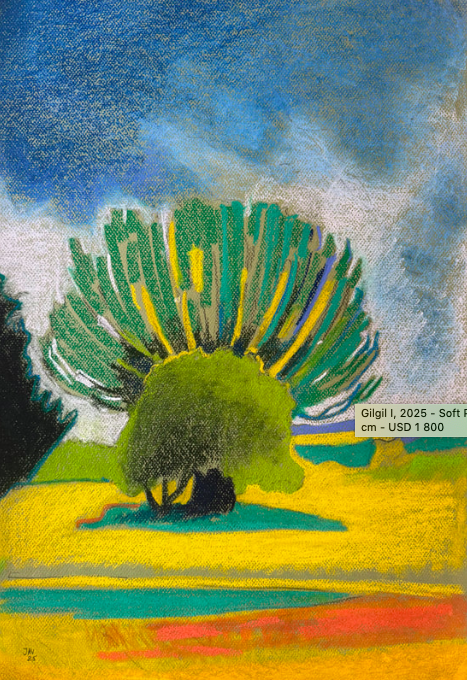
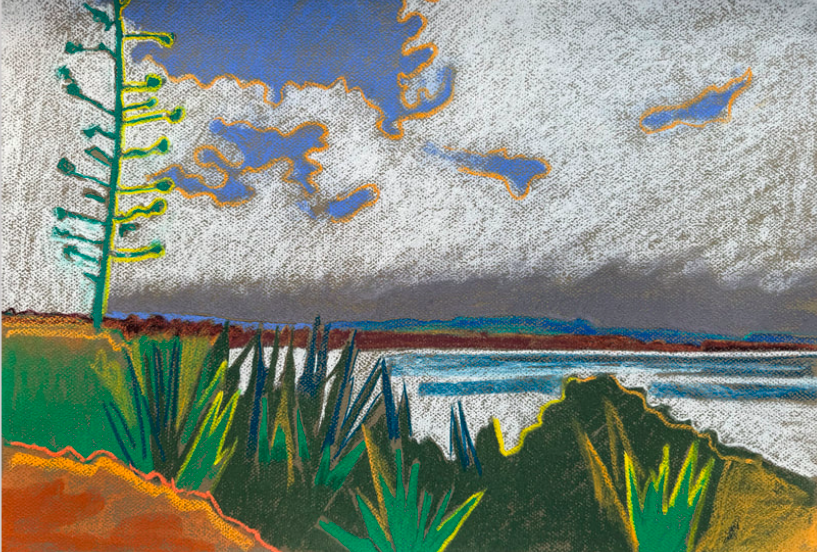
Gilgil I
Recent Works is James Vaulkhard’s first exhibition in Nairobi and is on show at the One-Off Contemporary Art Gallery until 19 October 2025. He is currently preparing for a showcase of large-scale figurative paintings to show in the UK in spring and has an upcoming exhibition at Art Miami this December.
Joy Mala (Joyce Odondi) is a writer and curator living in Ndenderu, Kenya. Her work encompasses poetry, podcasting, paintings, and gardening, all tied together with her deep intrigue with themes of nature and the vitality of the soul in all things.