


Screening: Saturday, 9 May, 4pm | Unseen Nairobi
—
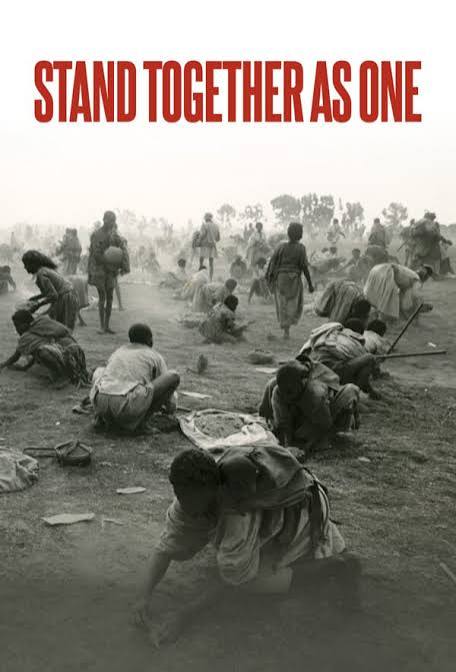
There is a particular cruelty in watching Chip Duncan’s magnificent documentary *Stand Together as One* in the spring of 2026. Not because the film is harrowing, though it is. Not because its central tragedy, the Ethiopian famine of 1983–85, belongs to the darkest chapters of the twentieth century. The cruelty lies in recognition: in the slow, sickening awareness that the world the film describes is a world we still urgently heed. A world in which mass starvation was hidden behind government propaganda, in which journalists risked everything to make the comfortable uncomfortable, in which ordinary people were finally moved to act.

*Stand Together as One* chronicles the historic events surrounding the famine, telling the story behind Kenyan photojournalist Mohamed Amin and BBC correspondents Michael Buerk and Mike Wooldridge as they overcame government restrictions and civil war to document the crisis. Their footage, once broadcast, became one of the most consequential acts of journalism of the modern era, inspiring the creation of Band Aid, U.S.A. for Africa and Live Aid. Duncan’s film is a reckoning with that chain reaction, with the strange, fragile, improbable alchemy by which images become empathy, and empathy becomes action.
The film is assembled with the assurance of a filmmaker who trusts his material. It features the final television interview with artist-activist Harry Belafonte, the final television interview with *We Are the World* organiser Ken Kragen, alongside Lionel Richie, Dionne Warwick, and BBC correspondent Michael Buerk. It also includes a rare interview with Ethiopian Prime Minister Meles Zenawi, recorded in Addis Ababa shortly before his death, in which Zenawi directly addresses the famine, the importance of small-scale agriculture, and Ethiopia’s need to move beyond reliance on foreign aid. These are not talking heads. They are witnesses, and Duncan, himself a photojournalist, understands the difference.

Never-before-seen footage and still photographs of the famine shot by Mohamed Amin have been restored for this production. There is a quiet reverence in how these images are handled. Amin, the Nairobi-based photojournalist whose camera first forced the world to confront what was happening in northern Ethiopia, is treated here not as a footnote to the celebrity philanthropy that followed, but as the moral and professional centre of the story. It is a correction long overdue, and particularly resonant given that this screening takes place in his adopted city. That the film is co-produced by Salim Amin, Mohamed’s son, lends it an intimacy that no amount of archival footage alone could achieve.
“Little in human history is more insidious than a dictator using food as a weapon against his enemies,” Duncan has said of the film’s subject. The Ethiopian government of Mengistu Haile Mariam actively concealed the scale of the famine; to document it was to commit an act of political defiance. Buerk, Wooldridge and Amin did so anyway. The documentary is, at its core, a love letter to that kind of courage: the courage of those who refuse to look away, and who wager that others, shown the truth, will refuse to look away too.
Whether that wager still holds is the question that will hang over the Unseen Nairobi screening like weather.
We live, in 2026, in a world of unprecedented visibility. Every atrocity is filmed. Every famine is documented. And yet the lesson of the Band Aid era, that witness creates conscience and conscience creates solidarity, seems to have partially dissolved. Over 72,000 Palestinians have been killed in Gaza since October 2023, a catastrophe unfolding in real time, livestreamed, photographed, debated and still grinding on. Sudan, now three years into a brutal civil war, has become the world’s worst humanitarian crisis, with famine confirmed in Darfur and Kordofan and the threat of it spreading to twenty additional areas. Some estimates place the Sudanese death toll at 400,000. Across the border, South Sudan teeters on the edge of full-scale famine, with over half its population facing acute food insecurity.
The images exist. The reports exist. The numbers are staggering. What, this film asks implicitly, is missing?
What is missing, *Stand Together as One* suggests, is not information but narrative. Not footage but story. What Mohamed Amin understood, and what this documentary beautifully articulates, is that a single photograph broadcast at the right moment to the right audience can accomplish what years of policy papers cannot. The Ethiopian famine did not end because statistics changed minds. It ended, in part, because a Kenyan cameraman stood in the dust and pointed his lens at a child, and because two BBC journalists found a way to get that image onto television screens in Bradford and Baltimore and Bordeaux. Story is the technology. It always has been.


This is why the film deserves to be seen not as a nostalgia trip or a period piece about the glorious eighties, but as a masterclass in the mechanics of humanitarian response. It is also, quietly, a film about Africa’s agency in its own story. About Amin, about Nairobi, about the continent not as a passive object of Western charity but as a place where extraordinary journalists make choices that change the world. That the film is screening at Unseen Nairobi, a venue that has built its identity around African creative voice and documentary truth-telling, feels not merely appropriate but necessary.

Duncan’s direction is unhurried and precise. He does not manipulate; he illuminates. He allows contradictions to breathe: the celebrity philanthropy of Live Aid was both genuinely lifesaving and, in retrospect, freighted with its own complications. The film does not flinch from those complexities, but it does not weaponise them either. It holds, with something close to grace, both the imperfection of the response and the irreducible rightness of the impulse behind it.
There is a moment near the film’s end, which I will not spoil, where the question of what we owe each other across borders and continents becomes almost unbearable in its simplicity. It is the kind of moment that good documentary cinema exists to produce: the sudden, vertiginous sense that you have been shown something true.
Forty years after Amin stood in that Ethiopian valley with his camera, the world still needs people willing to stand in those valleys, and audiences willing to sit with what they find there. *Stand Together as One* is an act of faith that we still can. On the evidence of the film itself, that faith is nor misplaced.
—
*Stand Together as One screens at Unseen Nairobi, Saturday 9 May, 4pm