

On Blood, Fabric, and the Alchemy of Memory
For Tizzita Tefera, art is not a departure from language but its continuation. Her visual work, she explains, “came out of poetry,” evolving from diarized words into images. Her crossing of mediums—writing, painting, collage, photography, installation, and performance—is central to her practice, which resists easy categorization. Tefera says her work:
Weaves together the visible and invisible, bringing together family archives, African fabrics, esoteric knowledge and intimate rituals of femininity”
Through this interweaving of media Tefera explores feminism, decoloniality, traditional crafts processes, shame, and the dualities of existence. Fundamentally, her works revolve around memory and transformation: facing inner shadows, processing experience, and conceptualizing those memories and experiences into form.
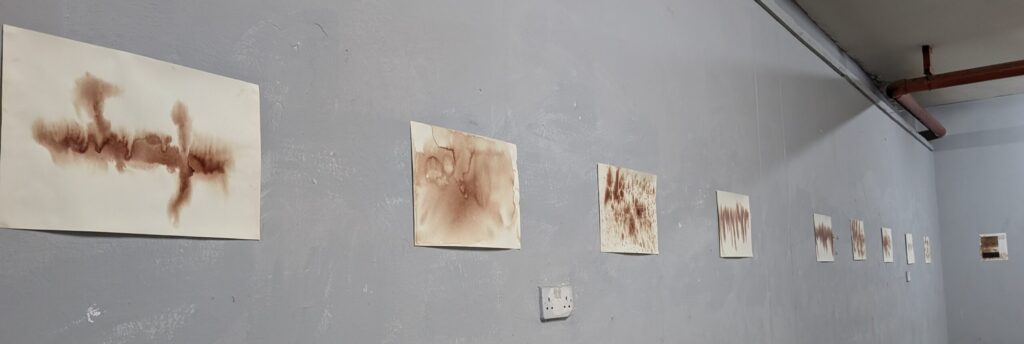
Tefera’s early Blood Works marked a turning point in her practice. Inspired in part by her readings of Carl Jung and her own passage through a “dark night of the soul,” Tefera began experimenting with menstrual blood as both medium and metaphor. Her first blood work manifested as a letter she wrote to her mother, who she calls her “portal”, a literal portal into this world, and a portal to creativity. She replaced ink with blood to write the letter. She described that from that first act of raw address, passing through this symbolic portal, a creative flood followed.
The process was both cathartic and confrontational. Although somewhat resistant to her self-constructed concept of menstrual blood as a medium, Tefera used the works as a way to face the shame and embarrassment historically tied to menstruation by putting it on the wall until the discomfort dissolved. “It was therapy,” she reflects, “and a way of seeing my shadow self.”
In these works, blood shifted from private marker to public demonstration. She created at least one work per day of each cycle with markmaking ranging from splatters to stamps to a fluidity echoing watercolours.
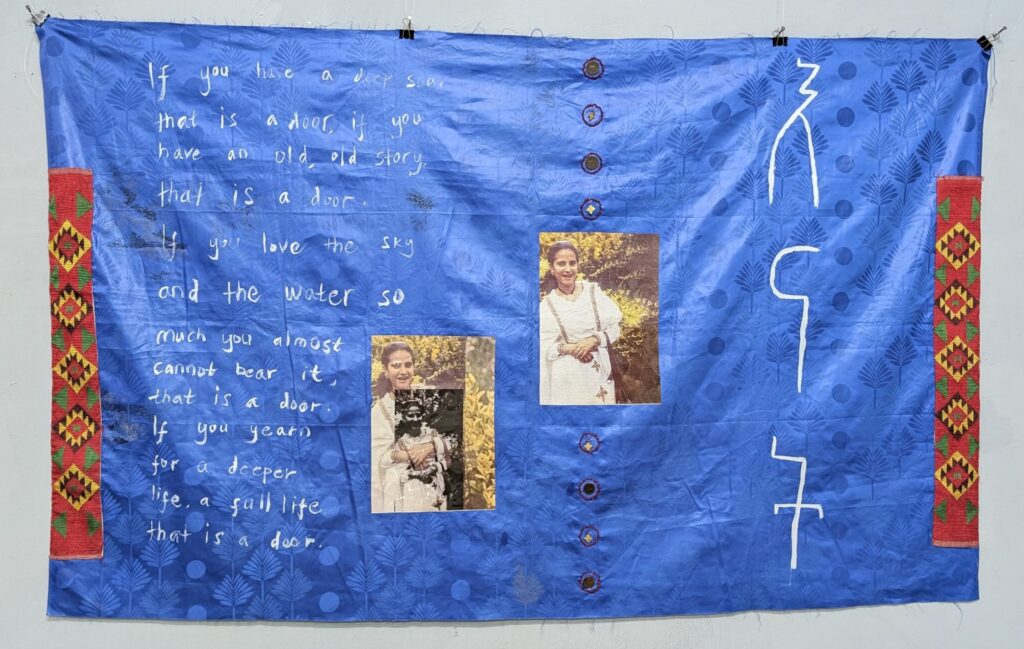
The act of writing, always central to Tefera’s practice, remained present in her practice: she records, diarises, and reads constantly, drawing meaning as much from the process as from the finished piece. Symbols—some inherited from African traditions, others self-created—thread through her work, layered with personal mythologies and collective histories. Several of her works contain symbols that resemble the Ge’ez script of her Ethiopian heritage, but are altered to form her own private communication.
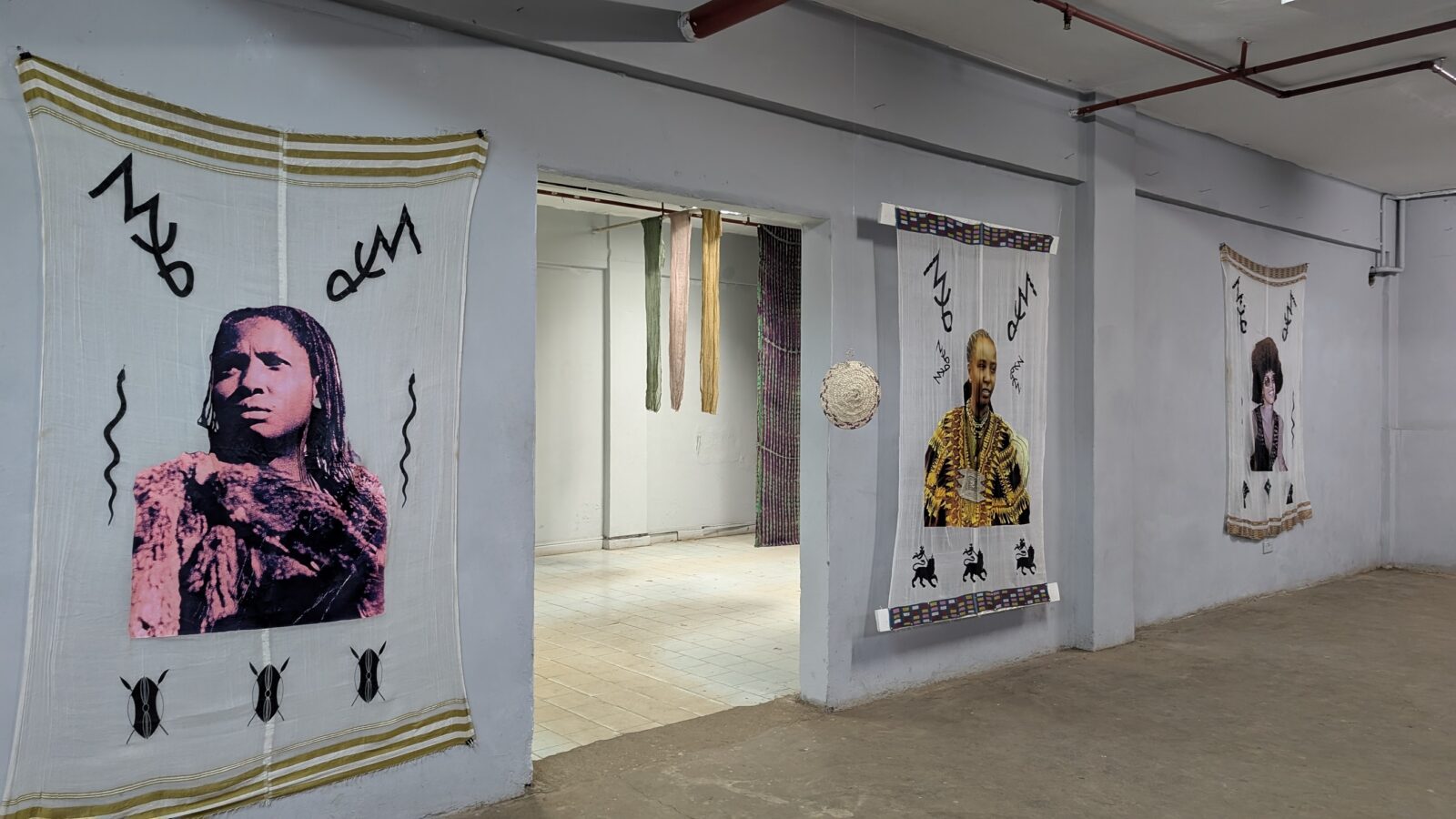
Tefera has incorporated snake symbols into her photocollage portraits of heroic women of Africa and the diaspora – Mau Mau Field Marshal Muthoni Kirima, Ethiopian Queen Taitu and American political activist and academic Angela Davis. She reflects on snakes and their tradition as protective and regenerative forces within a number of worldwide cultural frameworks, as opposed to thier vilified and harmful reputation in Christian iconography and legend.
Tefera employs fabrics in many of her works. She became interested in the concept of cloth as a language and a receptacle of histories, woven with signifiers of culture which pre-date written language and communicate identity concepts and other complex ideas. Tefera has reflected on how cloths and their presentation may serve as bridges for information within and between cultural groups.
Initially struck by the patterns of old African banknotes, which reminded her of kanga cloth, Tefera’s travels deepened her engagement with textiles and their encoded meanings. Colours, motifs, and weaves became a lens through which to learn the stories and pre-colonial histories of African countries. For her, fabrics function like archives, holding alternative narratives to those imposed by colonial histories. Collecting and learning these stories is as important for Tefera as is art-making itself.
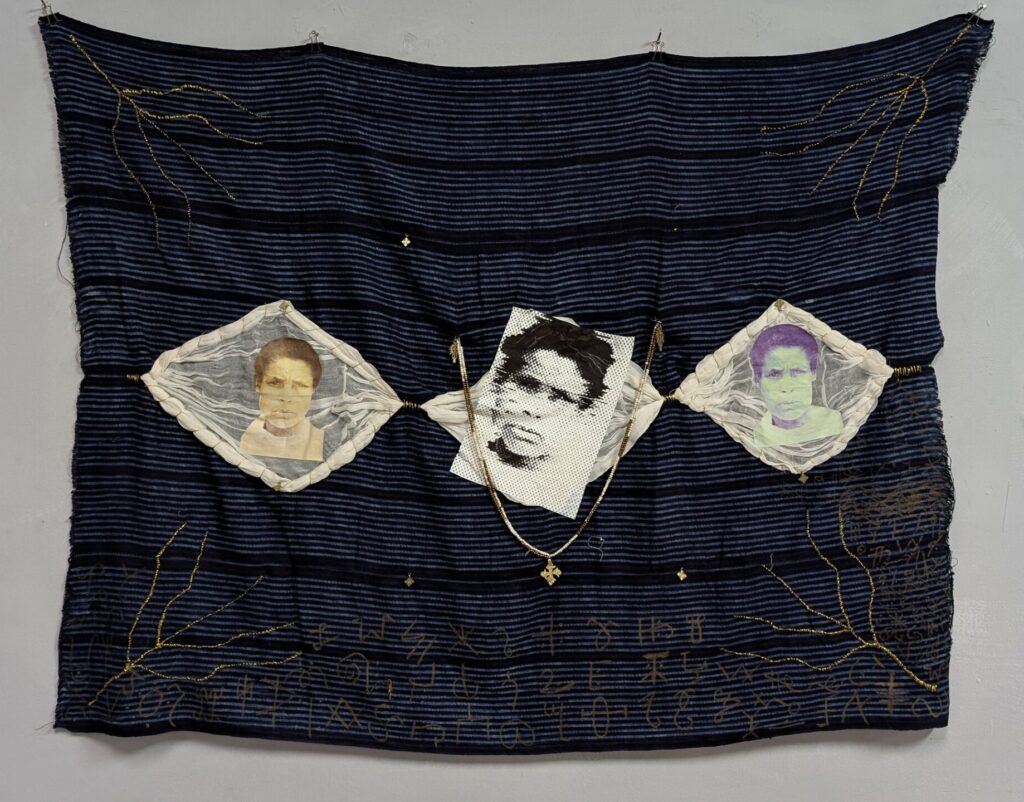
Through the use of African textiles and the inclusion of Ethiopian household items made of woven palm and grasses (meshrefe and sefed) Tefera also presents the concept that unlike the European tradition of art which is framed and hung on the wall, art in Africa has always been part of daily life, seen in clothing, household goods and adornments.

Photography has also shaped Tefera’s vision. Her family once owned a photo studio, and the act of self-documentation, capturing lives and preserving memory, filters into her compositions. Through her work she connects with her late grandmothers, weaving ancestral presence into contemporary form.
Tefera’s current projects return explicitly to heritage, foregrounding Pan-Africanism as a strong part of her identity. The large-scale photo-on-fabric works celebrating iconic Black women stand alongside her only male subject—her great-grandfather, whose role in Ethiopian history anchors her lineage. Here, fabrics again feature strongly, serving as literal backdrops to her collages and symbol-creating.
The scale, symbolism, and subject matter of Tefera’s work reflect her unrestricted, intuitive process. Her works’ meanings typically only become apparent after creation, she says. Yet it seems that her creative impulse is always to move toward connection: with ancestors, with heritage, and with her self. In Red Link, Tefera employs visual language as both an intimate record and a collective channel for disseminating history and tradition through a lens of decoloniality. In her hands, words and symbols migrate from notebook to fabric to wall; menstrual blood transforms into pigment; photography becomes memory’s anchor; and fabric shifts into language as she carries the past forward while reimagining the future.
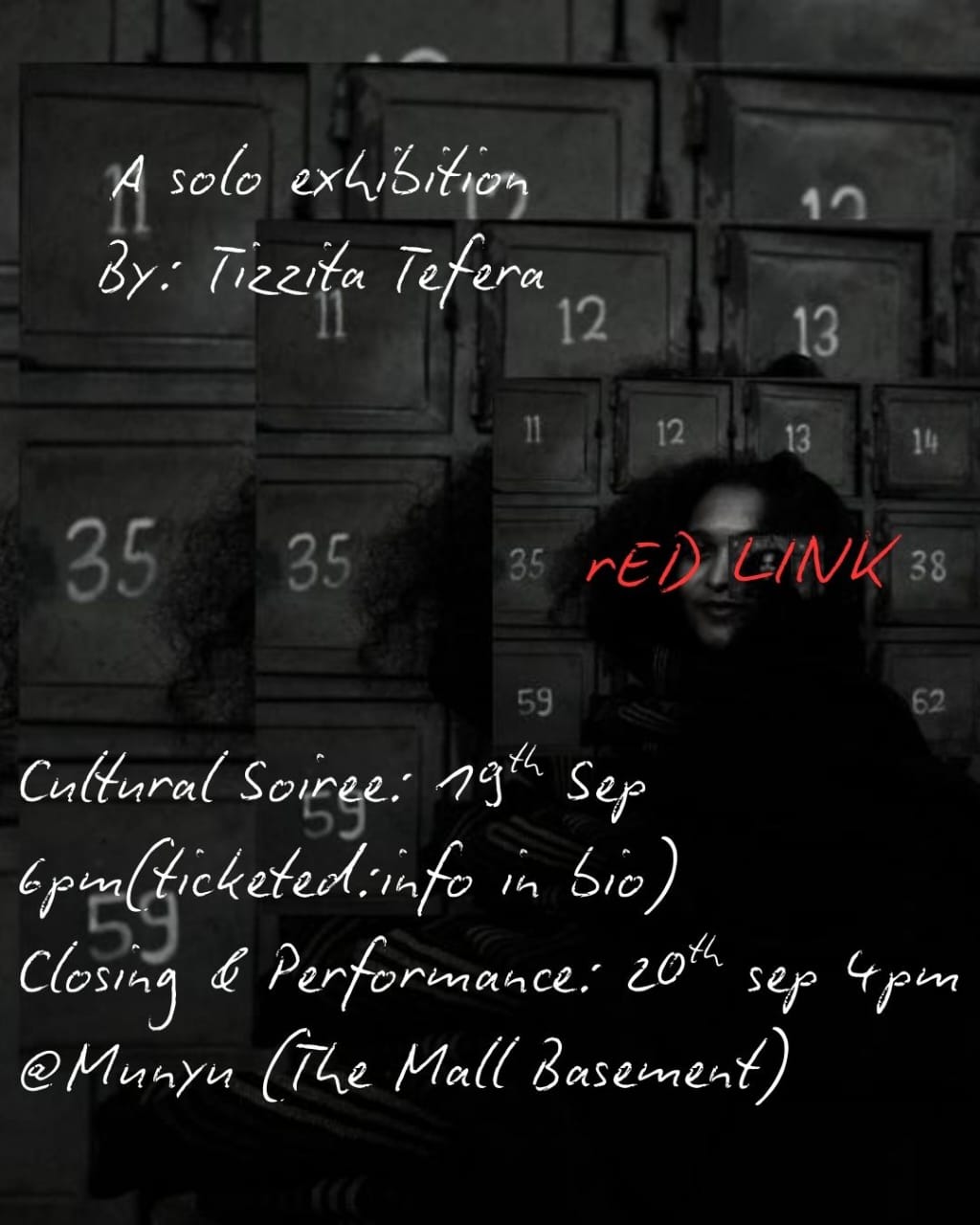
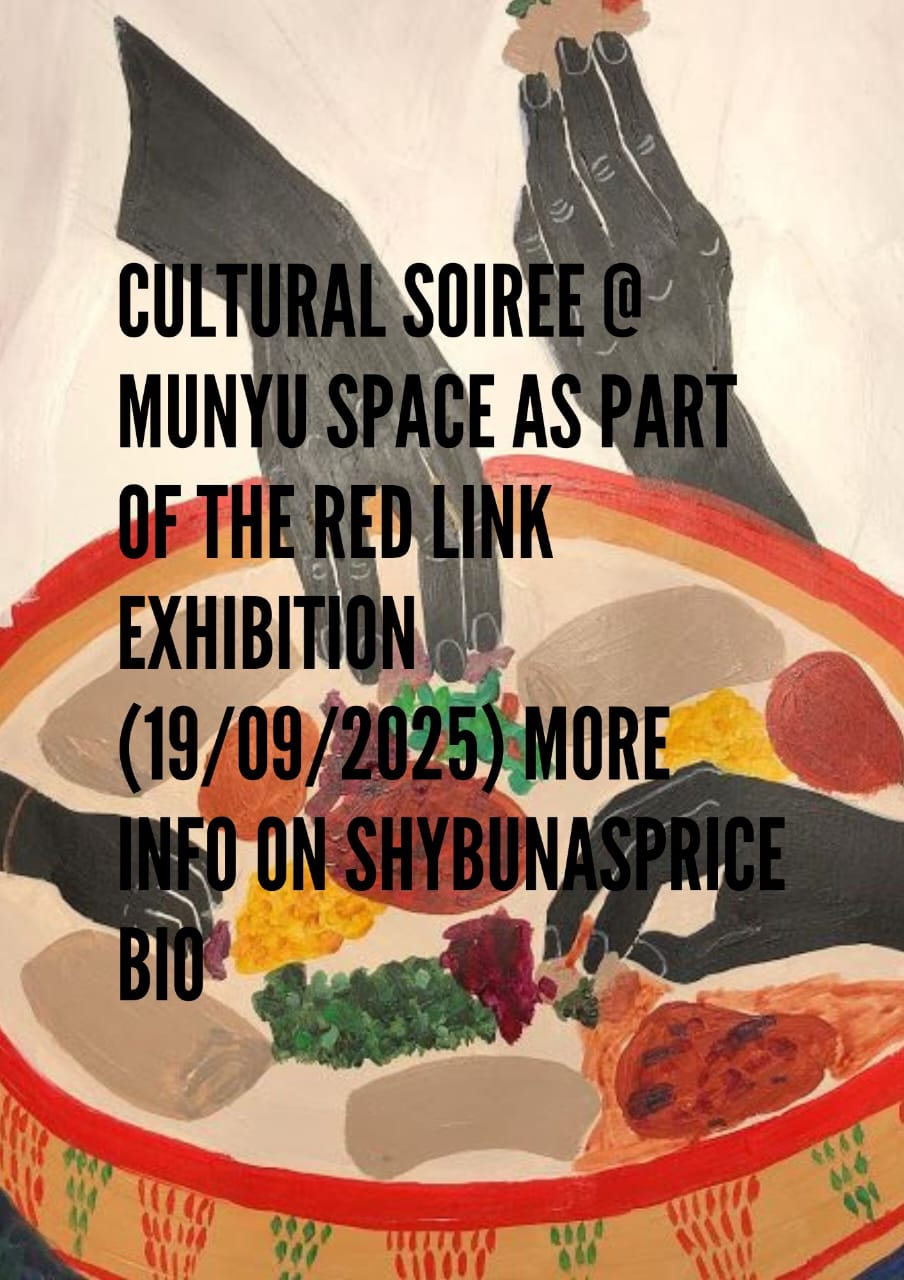
Red Link is showing at Munyu Space, The Mall (Basement) through Saturday 20 September, when there will be a closing performance. Additionally, on Friday 19 September, there is a ticketed Ethiopian food, music and art evening at the exhibition space. See the posters below and @shybunasprice on Instagram for more details.