


Since 2022 an incredible initiative in women’s transportation and healthcare has been shaping in Western Kenya. Boda Girls is empowering Kenyan women to own the road — and drive health, education, and opportunity into their communities.
Boda Girls is a Kenyan empowerment program that trains women to become professional boda boda drivers, enhancing their economic independence while providing safe, free transport for women to health services. Launched in 2022, they tackle sexual harassment, reduce maternal mortality, and provide specialized transportation to hospitals.
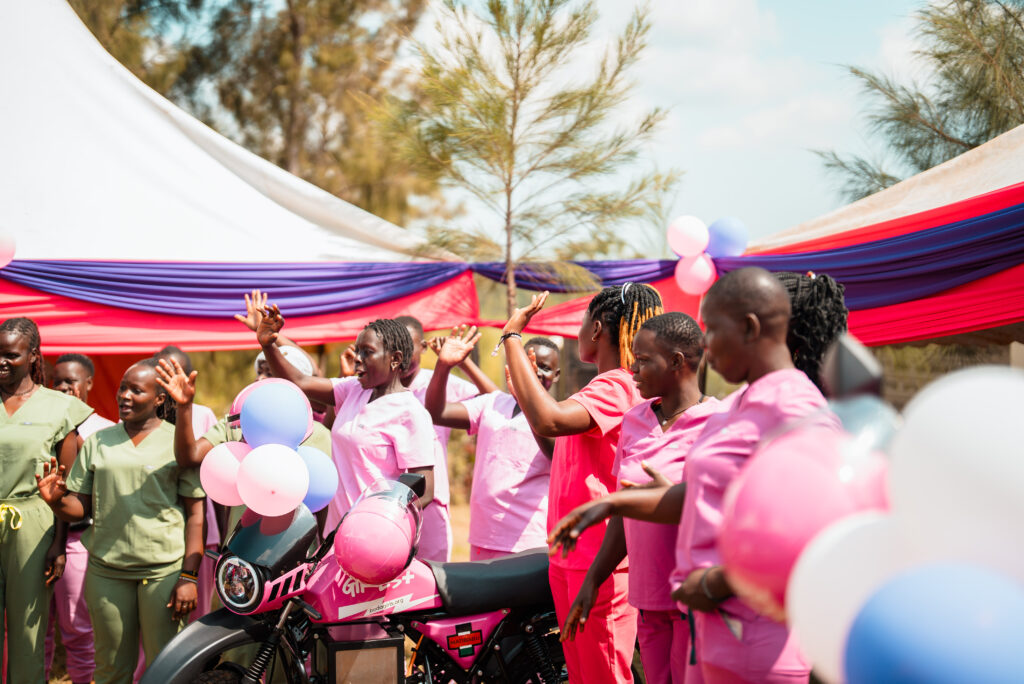
The initiative is a co-creation of Matibabu and Tiba Foundations. Their story is a powerful example of what can happen when committed oragizations come together to create meaningful change for women.
The Story
In October 2019, Diane Dodge and Dr. Rhiana Menen (Executive Director and Vice President, respectively, of the Tiba Foundation), visited the Matibabu Foundation in Siaya County, which provides family-centred health information and services. During their visit, they met with the principal of a local girls’ high school after a volunteer presentation. As they spoke they witnessed a moment that would prove to be a catalyst: a student climbed onto the back of a boda boda. As usual, the driver was a man. The principal expressed her concern that many of these drivers had been known to sexually harass schoolgirls.
Diane, a motorcyclist herself, asked why there were no women driving boda bodas. The principal paused and admitted she didn’t know – it had always been men. But she thought the idea of women boda drivers was compelling.
At the same time, Matibabu CEO Dan Ogola, a long-time advocate for women’s health, had been grappling with a rise in teen pregnancies linked to boda boda drivers and was already considering possible interventions.

Together, Dan, Diane, and Rhiana recognised an opportunity: training women to transport other women to hospital, free of charge, could not only help shift local perceptions but also tackle critical barriers to healthcare, including long distances, prohibitive transport costs, and the need for trusted support in navigating medical systems. As it stood, long distances to services and a lack of funds for transportation were significant barriers to local women seeking healthcare.
They got to work. Diane led programme design and curriculum development, Rhiana secured funding and partnerships, and Dan mobilized the community, bringing together a team ready to launch a new model in which women boda boda drivers would provide free transport for maternal health, family planning, and cancer care. Together, they celebrated the launch of the first cohort of Boda Girls in late 2022. Matibabu focused on building the riders’ technical skills, while Diane provided coaching in women’s empowerment and group facilitation.
What Change Looks Like
The results have been striking. During the 2023–2024 pilot period, Matibabu Hospital recorded a more than 60% increase in hospital births, alongside significant rises in family planning visits and cancer care uptake, surpassing any comparable period in its history. The Boda Girls riders saw their income increase on average from around 100 shillings per day to around 800. By the end of the training, 100% of the Boda Girls paid off their zero-interest motorcycle loans and own their business assets.

Boda Girls lease-to-own their motorcycles, paying off a zero-interest loan from the money they earn delivering women to the hospital – the equivalent of $1 per free ride and $5 per birth. They are also able use their vehicles to provide fee-paying rides within their communities. This model has allowed 100% of Boda Girls to own their motorcycles within two years.
Through a partnership with Roam Electric (www.roam-electric.com), many Boda Girls now ride Roam Air electric motorcycles, replacing petrol bikes with a more reliable and affordable way to reach women in remote communities.
In 2024, Boda Girls was accepted into the Harvard Business School Community Partners (HBSCP) program to evaluate the program’s impact and potential growth. HBSCP enthusiastically recommended scaling Boda Girls in two ways: Matibabu Hospital would remain focused on its local community in Siaya while serving as the Boda Girls Center of Excellence and model for replicating the program elsewhere. Meanwhile, the Tiba Foundation would take the lead on scaling by partnering with rural hospitals in other counties and sharing the brand, model, curriculum and training.
As an initial step in this process, Tiba and Matibabu Foundations’ boards supported the creation of a new Kenyan NGO called Boda Girls. The original Boda Girls at Matibabu leads vertical scaling within Siaya County, becoming the go-site for piloting new innovations like electric motorcycles and benchmarking, while the Boda Girls NGO leads horizontal scaling across Kenya, starting with counties around Lake Victoria. Tiba Foundation continues to provide financial assistance, partnership development, and strategic advice. Today, Boda Girls is led by CEO Nancy Akeyo, alongside a board of six Kenyan women with deep expertise in scaling women’s health and economic empowerment initiatives.

Boda Girls Today
The initiative now trains cohorts of women to become successful boda boda drivers and community health advocates. These drivers are typically the first females to own and operate boda bodas in their villages. As envisaged by Diane, Rhiana and Dan, Boda Girls provide rural women with free rides to clinics for preventive care, overcoming critical barriers such as long distances, lack of funds for transportation, and sexual harassment from male drivers, all of which often prevent rural women from accessing care, safely.
A key to Boda Girls’ success is male engagement. Boda Girls are reshaping gender norms in rural Kenya by earning community trust and male support through safe, reliable service. About 40% of their fee-paying passengers are now men. Once seen as competitors, many male drivers now collaborate with and even advocate for Boda Girls, recognizing that empowering women strengthens the entire community.

Driving Change
Crucially, Boda Girls are so much more than just boda drivers; they are health advocates and community leaders, equipped with a mastery of various competencies to support women of all ages, throughout critical times of their life.


In rural Kenya, limited access to menstrual health education, family planning, and affordable transport continues to undermine women’s health, with many forced to walk long distances or forgo essential care altogether. As Melinda French Gates notes, when women can plan and space their births, families are healthier and more economically secure.
Additionally, Kenya has one of the highest cervical cancer mortality rates in the world, and breast cancer cases are steadily rising. Over 70% of these cancers are diagnosed late, when treatment options are limited and outcomes are poor.

From Ride to Results: Community Engagement & Impact
Boda Girls respond to these interconnected challenges by delivering reproductive health education and providing free rides to clinics, enabling women’s access to family planning, antenatal and postnatal care, and cancer screening, ensuring women receive the support they need at every stage of life. As Melinda French Gates notes, when women can plan their families, outcomes improve across health, education, and income stability.
The power of sisterhood is central to the program: cohorts of 10 women are trained to open doors in their communities, breaking gender barriers in a traditionally male-dominated field and increasing their own daily income.
The economic impact extends to the Boda Girls’ families: children attend school without interruption, several have gone to college, and some women have purchased land or started side businesses, hiring their own employees.
Beyond improving women’s access to healthcare and enhancing their own and their families’ economic prospects, Boda Girls inspire entire communities, showing girls and women alike that a woman can do anything – even drive a motorcycle while earning a livelihood and supporting her family.

SUPPORT BODA GIRLS
Boda Girls is funded by Tiba Foundation, whose board of directors covers all fundraising and program management costs. That means 100% of your donation goes directly to programs supported by Tiba, including supporting Boda Girls and their lifesaving work in Kenyan communities.
Click here to learn about WAYS TO GIVE.