


Franz Cerami brought Kenya’s coffee workers to the walls of their own city and we were there to see it happen.
There’s a particular flutter that happens when you watch a building change under the skilled eye and hands of Cerami… and indeed a particular ‘handling’ by Cerami – you’re in good hands with this artist. One moment it’s just a wall concrete, familiar, inert. Then the projector fills the surface: a farmer, a picker, someone whose hands have moved through Kenya’s coffee supply chain in anonymity for years. For a few hours on the evenings of 28 and 29 May, Italian artist Franz Cerami made those faces impossible to ignore.

We followed the installation from start to finish. Jute Portraits, a project curated by Cerami alongside Vincenzo Del Monaco, Ambassador of Italy to Kenya, through the Italian Cultural Institute of Nairobi and the Embassy of Italy began at dark. By 7pm, attendees had gathered at Kenyatta University’s Art Complex: students of fine art and design, art lovers and a quiet contingent of technicians and visual recorders assembled around the equipment with the kind of focused calm that signals something real is about to happen.
Art projections at night, using Nairobi’s own cityscape as canvas, are not a common occurrence here. The streets tend not to double as galleries after dark. What Cerami does and has done across Naples, São Paulo, Tokyo, St. Petersburg, New Delhi is insist that they should.
Video mapping comes to Nairobi

Students at the university who had attended Cerami’s earlier workshop spoke about the experience with real enthusiasm. They spoke about the process, the philosophy and the experience working with Franz. The portraits, all approximately 300 of them, were filmed across Kenya’s coffee supply chain: farmers, pickers, processors and the communities around them.
Cerami then reworked each frame individually, so the faces that appeared on the university’s Art Complex walls were not raw footage but something far more deliberate. Video painting, projected onto surfaces as large as the artist deemed worthy of the image.
Jute (the material historically used to bag and transport coffee) runs through the work both literally and symbolically. It appears as a pictorial surface and a living material within the installations themselves, linking the visual language of the piece to the commodity at the centre of it.
Jute Portraits: Following through the city
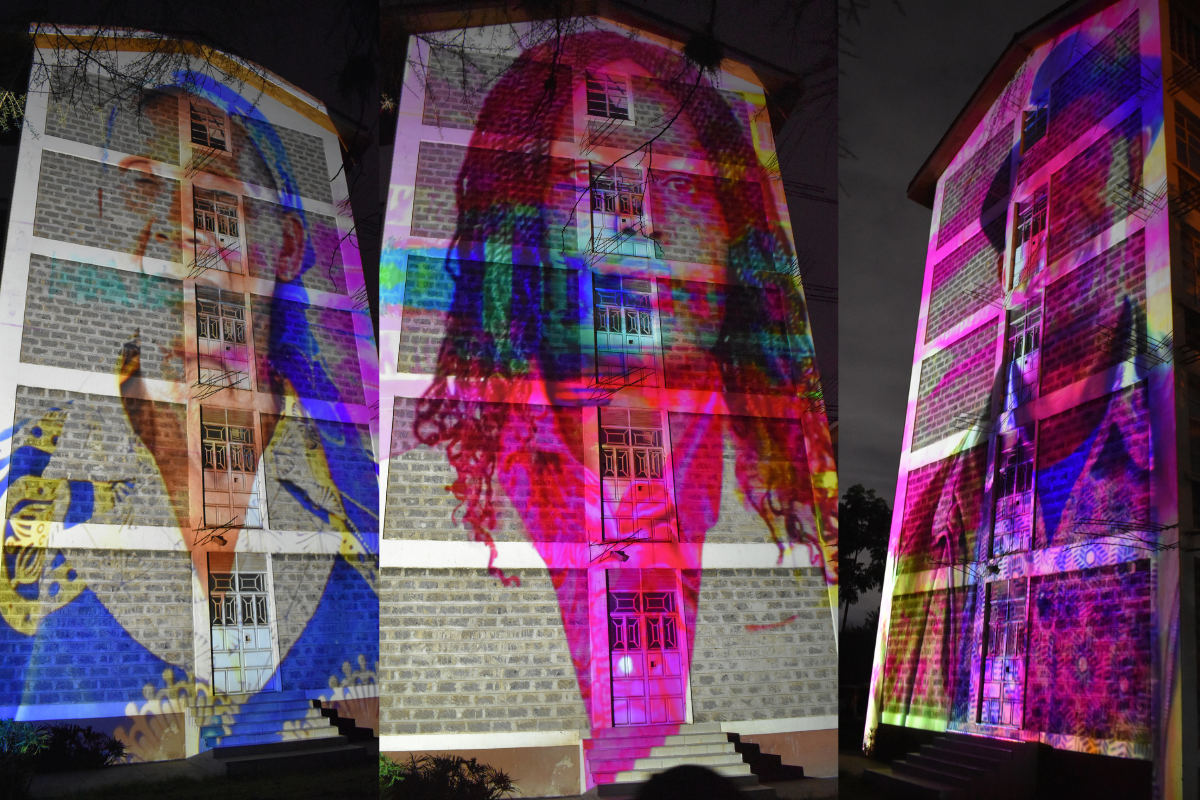
From the university, the entire group moved together, artist, technicians, recorders and attendees, making their way through the city in search of surfaces. The work follows the walls. You scout, you read the architecture, and you let it tell you what it wants to hold. Upper Hill offered something unexpected. The plaza architecture of the office parks there with wide facades, layered levels, and stacked geometries gave Cerami room to work at scale.

The projections here ran differently from Kenyatta University’s space, with images stacked on one another, the portraits multiplied and overlapping against the clean backdrops of corporate Nairobi. It was a striking contrast, and a deliberate one.
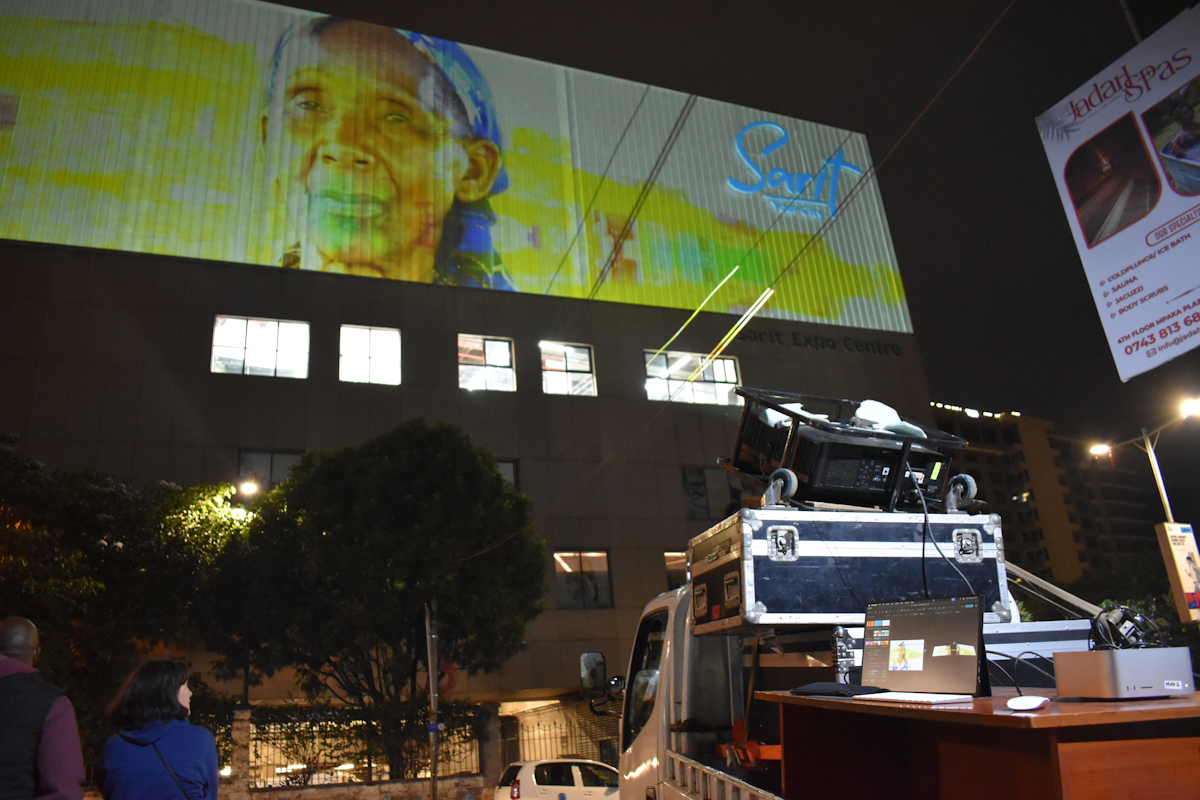
The final stop of the evening was Sarit Centre in Westlands, one of Nairobi’s most recognisable architectural landmarks.

A large horizontal projection swept across the full side of the building, the faces of Kenya’s coffee workers suddenly occupying some of the most prime visual real estate in the city. The scale of it, set against the Westlands skyline, was hard to look away from.



“I encountered faces, hands, gestures, landscapes and stories. From these encounters emerged portraits that I painted by hand, frame by frame, transforming them into moving images. For me, this work is a way of restoring dignity, colour and presence to a community that contributes every day to an economic, cultural and human story connecting Kenya and Italy.” — Franz Cerami

The iNTAKE
We at iNNAIROBI were genuinely stopped in our tracks at points during the evening. Not just by the projections themselves but by the infrastructure of intention behind them. The dedication of the team, the care that had gone into every frame, the fact that an artist spent weeks in residency here in March listening to these workers before ever picking up a projector. The portraits feel earned.

We also had the chance to speak with both Franz Cerami andAmbassador Vincenzo Del Monaco about the project, the process, and what art and diplomacy can build together in a city like Nairobi. Those conversations are coming.