


A new and ambitious exhibition opened at the Nairobi National Museum on 20 December. The exhibition aims to present a survey of the history of Kenyan art. As well as tracing the evolution of the art ecosystem in Kenya, this exhibition is extremely significant as it is simultaneously addressing the issue of the lack of a stand alone National Art Gallery in Kenya, and will be running for at least two years.
Wahenga wa Sanaa brings items from the National Museums of Kenya rich collection of contemporary East African art into public view in the context of prehistoric and ethnographic items, also from the archives. The exhibition focuses on powerful themes of cultural identity, spirituality, history and politics, and nature and environment. Additionally, the exhibition traces the growth of a formal art ecoscape and its supporting institutions.
The curators intend for the exhibition to honour the wahenga, the wise ancestors and cultural forebears whose creativity laid the foundation for generations of artists.
The exhibition presents items ranging from crafted historical artefacts through to contemporary artworks of the current era, beginning with items from the 1800s to set the audience a framework from which to understand the enduring legacy upon which contemporary Kenyan art is built.

Installation view. Photo by author.
Kenya’s visual arts history is deeply shaped by a long, unfinished pursuit of a National Art Gallery. For more than five decades, artists, curators, and cultural advocates have pushed for a permanent public institution that could collect, preserve, and present Kenyan art within a national framework. Although this vision has repeatedly come close to realisation, it has never fully materialised.
In its absence, private galleries, artist-run spaces, and foreign cultural centres have carried much of the responsibility for sustaining artistic practice and public engagement. Today, the Nairobi Gallery and the Creativity Gallery at the Nairobi National Museum partially perform this role, even as Kenya still lacks a formally designated National Art Gallery. It feels as if the exhibition is, in fact, attempting to rectify the lack of a national gallery as extensively as possible, in one room.
The foundations of Kenya’s modern art ecosystem were laid in the late colonial and early independence period. The Esso Art Calendar, which ran from 1955 to 1980, was a critical platform for nurturing artistic talent and building public awareness of visual art. Sorsbie Art Gallery, established in 1960 in Muthaiga, became an early centre for East African art, while Elimo Njau’s involvement there and his later co-founding of Paa ya Paa Arts Centre in 1965 marked a decisive shift toward indigenous, artist-led spaces. Paa ya Paa, widely regarded as Kenya’s first indigenous African art centre, rejected the then prevalent tourist-driven aesthetics and sought to foreground authentic African expression. At the same time, foreign cultural institutions such as the Goethe-Institut, the British Council, and the French Cultural Centre (Alliance Française) have all played a crucial role by offering exhibition spaces, dialogue, and livelihoods to artists at a time when local infrastructure was limited.

“Ibis” by Elkana Ong’esa. Photo by author.
Parallel to these institutional developments, distinct regional and popular art movements shaped East Africa’s visual language. Makonde carving traditions from Tanzania and Mozambique became internationally recognised for their expressive Shetani figures and tree-of-life sculptures, while in Kenya, the organised Kamba art movement initiated by Mutisia Munge focused on carved figurines and functional objects inspired by Zaramo models. In western Kenya, Kisii soapstone carving evolved from utilitarian forms into sculptural art, with Elkana Ong’esa emerging as a key figure. These movements coexisted with more informal and popular expressions such as Ringo Arts, introduced by Congolese artists in Nairobi. Through colourful landscapes and commissioned paintings for bars, salons, and social spaces, Ringo artists embedded art into everyday urban life, using apprenticeship models to spread their influence and paving the way for later public art and street-based practices.
Efforts to establish a National Art Gallery surfaced early in independent Kenya. In 1966, Joseph Murumbi, then Vice President, attempted to convert the former Provincial Commissioner’s office, now the Nairobi Gallery, into a national art space, though the plan was never realised. A more advanced attempt came in the late 1970s when the government acquired the Moi Avenue building now housing the Kenya National Archives and allocated it for a National Art Gallery. Funds were set aside, and more than 3,000 artworks were collected in preparation for an inaugural exhibition. However, shifting priorities led to the relocation of the national archives and the Joseph Murumbi Pan-African Collection into the same building, effectively ending the initiative. This marked the second major setback in the pursuit of a national art institution.

“Divorcing a Husband the Traditional Kikuyu Way” by Asaph Ng’ethe Makua
Despite these disappointments, the art scene continued to expand and diversify. The 1970s and early 1980s were characterised by strong currents of Pan-Africanism, nationalism, and political consciousness, reinforced by the growth of art education at institutions such as the University of Nairobi, Kenyatta University, the Creative Arts Centre, and the YMCA. In 1981, renewed government engagement led to the formation of the National Visual Arts Committee and the staging of Utamaduni wa Sanaa at Nairobi City Hall, an exhibition intended as a precursor to a permanent National Art Gallery.
When the promised follow-through failed to materialise, artists responded directly. Sukuro Etale and others formed the groundbreaking Sisi kwa Sisi movement, taking art into streets, social halls, and open-air spaces to address social injustice, colonial legacies, and political realities, demonstrating resilience in the face of institutional neglect.
From the mid-1980s onward, private galleries and artist-led initiatives became increasingly central. Gallery Watatu, revitalised by Ruth Schaffner, emerged as a vital platform for emerging and established artists, while the Gallery of Contemporary East African Art, established at the Nairobi National Museum by Kenya Museum Society volunteers, responded directly to the absence of a national collection of contemporary art.

“Tree of Life” by Geraldine Robarts
Cultural centres continued to provide safe spaces for politically engaged work, and donor-driven initiatives funded civic education and activist art through murals, calendars, and public campaigns. Artist-run spaces such as Banana Hill Art Gallery, the Ngecha Artists Association, and later Kuona Trust and the GoDown Arts Centre decentralised artistic production and advocacy, reinforcing the role of artists as organisers of their own platforms.
By the 1990s and early 2000s, Kenya’s art world had become increasingly pluralistic, marked by private patronage, tourist art, public monuments, and a growing network of galleries, collectives, and training institutions. Although a National Art Gallery remained elusive, religious institutions, private sector bodies, and government departments continued to support artists through commissions and acquisitions. A third attempt to establish a national gallery emerged in the 2000s under the National Museums of Kenya, gaining formal board endorsement and culminating in a draft Cabinet Memo in 2020. Yet once again, implementation stalled, leaving the dream deferred.
It is within this historical and institutional context that Wahenga wa Sanaa takes on its full significance. Drawing from the National Museums of Kenya’s collection, the exhibition traces artistic legacies from prehistoric times through to 1980, foregrounding cultural identity, spirituality, politics, environment, and the development of art institutions. The artworks presented throughout the exhibition follow this trajectory.

Installation view – cultural artefacts from the museum’s collection. Photo by author.
Kenyan traditional art reflects generations of creativity expressed through everyday life. From the 1800s though today, artists have carved, moulded, woven, and adorned objects using natural materials including wood, stone, shell, and clay to craft items such as masks, jewellery, textiles, decorated gourds, stools, pots, and ornaments revealing both beauty and purpose, form and function. These items and traditions from Kenya’s diverse heritage continue to inspire contemporary design and artistic expression.
Objects such as the Kipsigis Ngecheret stool reveal how functional forms carried complex intellectual, symbolic, and aesthetic meanings, demonstrating that artistry in Kenya has always been embedded in daily life.

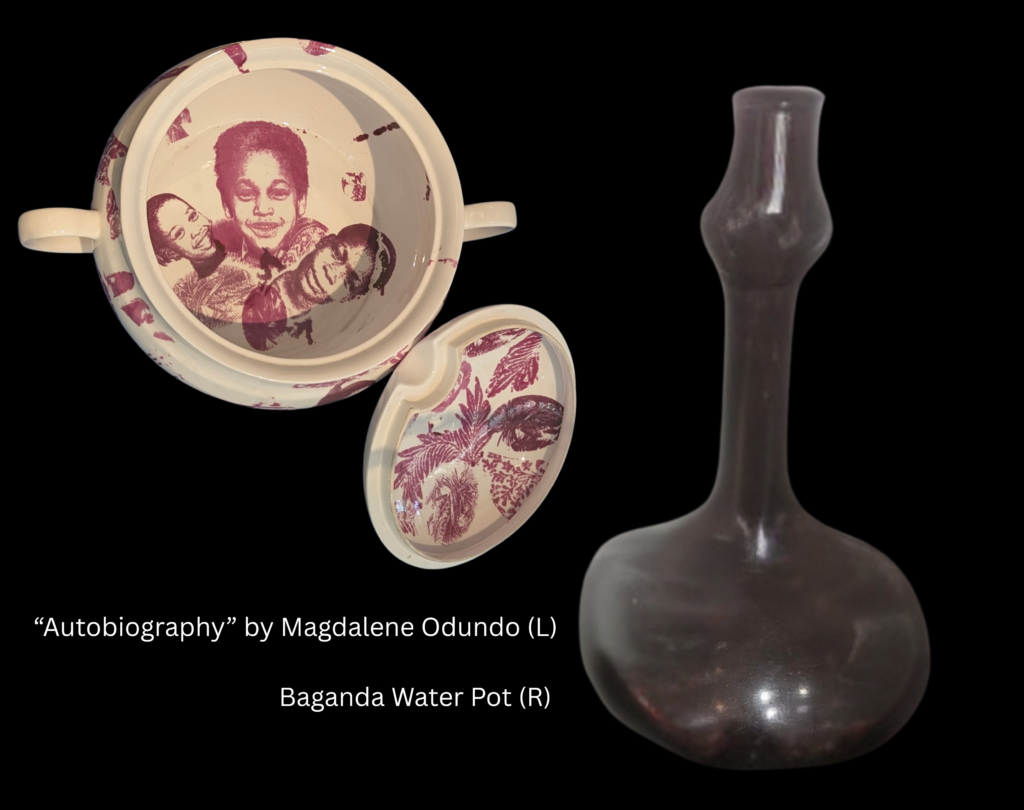
A photo-transferred ceramic piece by Dame Magdalene Odundo (“Autobiography”) is displayed near to a burnished gourd-shaped Bugandan vessel, highlighting Odundo’s research into millenia-old African pottery building techniques.
Contemporary art in Kenya developed within an East African context of shared histories. Leonard Kateete was born in Uganda but established himself in Kenya in 1980 and is well known for his large scale portraits that document diverse East African communities.
Theresa Musoke is another Ugandan-Kenyan painter represented in the exhibition. She is most well known for her experimentational and expressive depictions of Kenyan wildlife and women’s experiences in Africa, and here we see an example in the form of a black and white woodcut print.

Woodcut print by Theresa Musoke. Photo by author.
We are privileged to see the works of artists from the 1980s and 90s such as images of traditional homesteads captured by Fred Oduya; cultural collages by Rosemary Karuga; and moulded leather mirror frames crafted by Moses Ekui – where the artists have embraced new media and styles while retaining deep cultural traditions such as storytelling.
Saa Gamba, whose oil-on-canvas “Wall of the Untold” (1981) is presented, was a pioneering artist and filmmaker, directing over 22 documentaries for Voice of Kenya. Through his films and his paintings, he captured a world that he feared would be forgotten.
Wanyu Brush, who adopted this professional moniker to signify his total immersion in his art, began his career in 1989 with a debut exhibition at the French Cultural Centre. Since then he has remained a pivotal and dynamic figure in the Kenyan art world, often touching on social and political themes.
These are but a few of the artists in this wide-ranging show. In positioning ancestral art histories alongside the evolving narrative of modern Kenyan art, the exhibition encourages us to see the progression of Kenyan art as a dialogue between past and present and between tradition and innovation. By celebrating the Wahenga the exhibition affirms the depth and continuity of Kenya’s artistic heritage, even as the search for a permanent national home for art continues.
Wahenga wa Sanaa at the Nairobi National Museum, Creativity Gallery runs until December 2027. Museum entry rates apply.
The exhibition is funded by The Kenya Museum Society.